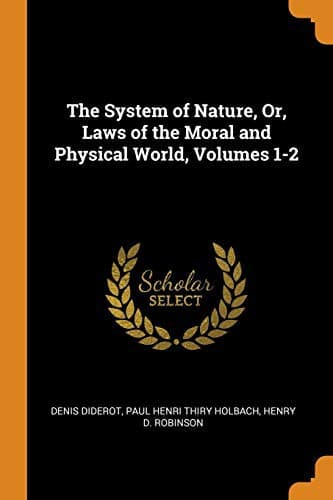
The System of Nature, or, the Laws of the Moral and Physical World. Volume 2Holbach, Paul Henri Thiry, baron d'
Religion
The System of Nature, or, the Laws of the Moral and Physical World. Volume 2
Holbach, Paul Henri Thiry, baron d'
Materialism; Philosophy and religion; Psychology
Without a very marked derangement of our organs, our sentiments hardly
ever vary upon those objects which either our senses experience, or
which reason has clearly demonstrated, In whatever circumstances we are
found, we have no doubt either upon the whiteness of snow, the light
of day, or the utility of virtue. It is not so with those objects which
depend solely upon our imagination--which are not proved to us by the
constant evidence of our senses; we judge of them variously, according
to the dispositions in which we find ourselves. These dispositions
fluctuate by reason of the involuntary impulse which our organs every
instant receive, on the part of an infinity of causes, either exterior
to ourselves, or else contained within our own frame. These organs are,
without our knowledge, perpetually modified, either relaxed or braced
by the density, more or less, of the atmosphere; by heat and by cold; by
dryness and by humidity; by health and by sickness; by the heat of the
blood; by the abundance of bile; by the state of the nervous system, &c.
These various causes have necessarily an influence upon the momentary
ideas, upon the instantaneous thoughts, upon the fleeting opinions of
man, He is, consequently, obliged to see under a great variety of hues,
those objects which his imagination presents to him; without it all
times having the capacity to correct them by experience: to compare them
by memory. This, without doubt, is the reason why man is continually
obliged to view his gods, to contemplate his superstitious systems,
under such a diversity of aspects, in different periods of his
existence. In the moment, when his fibres find themselves disposed to
he tremulous, he will be cowardly, pusillanimous; he will think of these
systems only with fear and trembling. In the moment, when these same
fibres shall have more tension, he will possess more firmness, he will
then view these systems with greater coolness. The theologian will call
his pusillanimity, "inward feeling;" "warning from heaven;" "secret
inspiration;" but he who knoweth man, will say that this is nothing
more than a mechanical motion, produced by a physical or natural cause.
Indeed, it is by a pure physical mechanism, that we can explain all the
revolutions that take place in the system, frequently from one minute
to another; all the fluctuations in the opinions of mankind; all the
variations of his judgment: in consequence of which we sometimes see him
reasoning justly, sometimes in the most irrational manner.
Public-domain text, read in full here on John Shaqi.
Reviews
Reviews
No reviews yet
Be the first to share your thoughts on this work.
Elsewhere in the archive
Join the Discussion
Join the discussion
Sign in to leave a comment or review.
Sign InorCreate an account