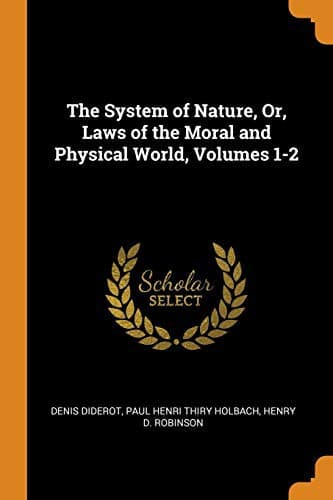
The System of Nature, or, the Laws of the Moral and Physical World. Volume 2Holbach, Paul Henri Thiry, baron d'
Religion
The System of Nature, or, the Laws of the Moral and Physical World. Volume 2
Holbach, Paul Henri Thiry, baron d'
Materialism; Philosophy and religion; Psychology
We agree with Derham, that atheists are rare; but then we also say,
that superstition has so disfigured nature, so entangled her
rights--enthusiasm has so dazzled the human mind-terror has so disturbed
the heart of man--imposture has so bewildered his imagination--tyranny
has so enslaved his thoughts: in fine, error, ignorance, and delirium
have so perplexed and confused the clearest ideas, that nothing is
more uncommon than to find men who have sufficient courage to undeceive
themselves on notions which every thing conspires to identify with their
very existence. Indeed, many theologians in despite of those bitter
invectives with which they attempt to overwhelm the men they choose
to call atheists, appear frequently to have doubted whether any ever
existed in the world. Tertullian, who, according to modern systems,
would be ranked as an atheist, because he admitted a corporeal God,
says, "Christianity has dissipated the ignorance in which the Pagans
were immersed respecting the divine essence, and there is not an artizan
among the Christians who does not see God, and who does not know him."
This uncertainty of the theologic professors was, unquestionably,
founded upon those absurd ideas, which they ascribe to their
adversaries, whom they have unceasingly accused with attributing every
thing to chance--to blind causes--to dead, inert matter, incapable of
self-action. We have, I think, sufficiently justified the partizans
of nature against these ridiculous accusations; we have throughout the
whole proved, and we repeat it, that chance is a word devoid of sense,
which as well as all other unintelligible words, announces nothing but
ignorance of actual causes. We have demonstrated that matter is not
dead; that nature, essentially active and self-existent, has sufficient
energy to produce all the beings which she contains--all the phenomena
we behold. We have, throughout, made it evident that this cause is much
more tangible, more easy of comprehension, than the inconceivable theory
to which theology assigns these stupendous effects. We have represented,
that the incomprehensibility of natural effects was not a sufficient
reason for assigning to them a system still more incomprehensible than
any of those of which, at least, we have a slight knowledge. In fine, if
the incomprehensibility of a system does not authorize the denial of
its existence, it is at least certain that the incompatibility of the
attributes with which it is clothed, authorizes the assertion, that
those which unite them cannot be any thing more than chimeras, of which
the existence is impossible.
Public-domain text, read in full here on John Shaqi.
Reviews
Reviews
No reviews yet
Be the first to share your thoughts on this work.
Elsewhere in the archive
Join the Discussion
Join the discussion
Sign in to leave a comment or review.
Sign InorCreate an account