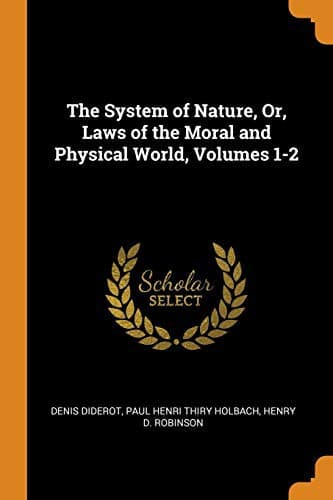
The System of Nature, or, the Laws of the Moral and Physical World. Volume 2Holbach, Paul Henri Thiry, baron d'
Religion
The System of Nature, or, the Laws of the Moral and Physical World. Volume 2
Holbach, Paul Henri Thiry, baron d'
Materialism; Philosophy and religion; Psychology
After having proved the existence of those whom the superstitious bigot,
the heated theologian, the inconsequent theist, calls _atheists_, let us
return to the calumnies which are so profusely showered upon them by
the deicolists. According to Abady, in his _Treatise on the Truth of the
Christian Religion_, "an atheist cannot be virtuous: to him virtue is
only a chimera; probity no more than a vain scruple; honesty nothing
but foolishness;--he knoweth no other law than his interest: where this
sentiment prevails, conscience is only a prejudice; the law of nature
only an illusion; right no more than an error; benevolence hath no
longer any foundation; the bonds of society are loosened; the ties of
fidelity are removed; friend is ready to betray friend; the citizen to
deliver up his country; the son to assassinate his father, in order
to enjoy his inheritance, whenever they shall find occasion, and that
authority or silence shall shield them from the arm of the secular
power, which alone is to be feared. The most inviolable rights, and
most sacred laws, must no longer be considered, except as dreams
and visions." Such, perhaps, would be the conduct, not of a feeling,
thinking, reflecting being, susceptible of reason; but of a ferocious
brute, of an irrational wretch, who should not have any idea of the
natural relations which subsist between beings, reciprocally necessary
to each other's happiness. Can it actually be supposed, that a man
capable of experience, furnished with the faintest glimmerings of sound
sense, would lend himself to the conduct which is here ascribed to the
atheist; that is to say, to a man who is conversant with the evidence of
facts; who ardently seeks after truth; who is sufficiently susceptible
of reflection, to undeceive himself by reasoning upon those prejudices
which every one strives to shew him as important; which all voices
endeavour to announce to him as sacred? Can it, I repeat, be supposed,
that any enlightened, any polished society, contains a citizen so
completely blind, not to acknowledge his most natural duties; so very
absurd, not to admit his dearest interests; so completely besotted not
to perceive the danger he incurs in incessantly disturbing his fellow
creatures; or in following no other rule, than his momentary appetites?
Is not every human being who reasons in the least possible manner,
obliged to feel that society is advantageous to him; that he hath need
of assistance; that the esteem of his fellows is necessary to his own
individual happiness; provoked, that he has every thing to fear from
the wrath of his associates; that the laws menace whoever shall dare to
infringe them? Every man who has received a virtuous education, who
has in his infancy experienced the tender cares of a parent; who has in
consequence tasted the sweets of friendship; who has received kindness;
who knows the worth of benevolence; who sets a just value upon equity;
Public-domain text, read in full here on John Shaqi.
Reviews
Reviews
No reviews yet
Be the first to share your thoughts on this work.
Elsewhere in the archive
Join the Discussion
Join the discussion
Sign in to leave a comment or review.
Sign InorCreate an account