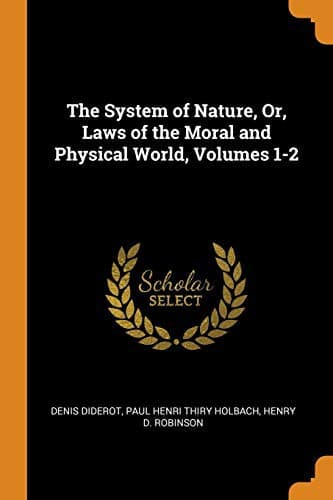
The System of Nature, or, the Laws of the Moral and Physical World. Volume 2Holbach, Paul Henri Thiry, baron d'
Religion
The System of Nature, or, the Laws of the Moral and Physical World. Volume 2
Holbach, Paul Henri Thiry, baron d'
Materialism; Philosophy and religion; Psychology
There is, perhaps, no theological question, which has not
been the source of immense mischief to man; whilst all the writings of
those denominated atheists, whether ancient or modern, have never caused
any evil but to their authors; whom dominant imposture has frequently
immolated at his deceptive shrine.
The principles of atheism are not formed for the mass of the people,
who are commonly under the tutelage of their priests; they are
not calculated for those frivolous capacities, not suited to those
dissipated minds, who fill society with their vices, who hourly afford
evidence of their own inutility; they will not gratify the ambitious;
neither are they adapted to intriguers, nor fitted for those restless
beings who find their immediate interest in disturbing the harmony
of the social compact: much less are they made for a great number of
persons, who, enlightened in other respects, have not sufficient courage
to divorce themselves from the received prejudices.
So many causes unite themselves to confirm man in those errors which he
draws in with his mother's milk, that every step that removes him from
these endeared fallacies, costs him uncommon pain. Those persons who
are most enlightened, frequently cling on some side to the general
prepossession. By giving up these revered ideas, we feel ourselves, as
it were, isolated in society: whenever we stand alone in our opinions,
we no longer seem to speak the language of our associates; we are apt
to fancy ourselves placed on a barren, desert island, in sight of a
populous, fruitful country, which we can never reach: it therefore
requires great courage to adopt a mode of thinking that has but few
approvers. In those countries where human knowledge has made some
progress; where, besides, a certain freedom of thinking is enjoyed, may
easily be found a great number of deicolists, theists, or incredulous
beings, who, contented with having trampled under foot the grosser
prejudices of the illiterate, have not dared to go back to the
source--to cite the more subtle systems before the tribunal of reason.
If these thinkers did not stop on the road, reflection would quickly
prove to them that those systems which they have not the fortitude
to examine, are equally injurious to sound ratiocination, fully
as revolting to good sense, quite as repugnant to the evidence
of experience, as any of those doctrines, mysteries, fables, or
superstitious customs, of which they have already acknowledged the
futility; they would feel, as we have already proved, that all these
things are nothing more than the necessary consequences of those
primitive errors which man has indulged for so many ages in succession;
that in admitting these errors, they no longer have any rational cause
to reject the deductions which the imagination has drawn from them. A
little attention would distinctly shew them, that it is precisely these
errors that are the true cause of all the evils of society; that those
Public-domain text, read in full here on John Shaqi.
Reviews
Reviews
No reviews yet
Be the first to share your thoughts on this work.
Elsewhere in the archive
Join the Discussion
Join the discussion
Sign in to leave a comment or review.
Sign InorCreate an account