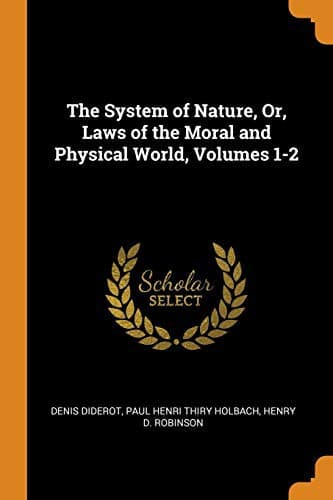
The System of Nature, or, the Laws of the Moral and Physical World. Volume 2Holbach, Paul Henri Thiry, baron d'
Religion
The System of Nature, or, the Laws of the Moral and Physical World. Volume 2
Holbach, Paul Henri Thiry, baron d'
Materialism; Philosophy and religion; Psychology
Thus the atheist, however wicked he may be supposed, will at most be
upon a level with the devotee, whose superstition encourages him to
commit crimes, which it transforms into virtue. As to conduct, if he
be debauched, voluptuous, intemperate, adulterous, the atheist in
this differs in nothing from the most credulously superstitious, who
frequently knows how to connect these vices with his credulity, to
blend with his superstition certain atrocities, for which his priests,
provided he renders due homage to their power, especially if he augments
their exchequer, will always find means to pardon him. If he be in
Hindoostan, his brahmins will wash him in the sacred waters of the
Ganges, while reciting a prayer. If he be a Jew, upon making an
offering, his sins will be effaced. If he be in Japan, he will be
cleansed by performing a pilgrimage. If he be a Mahometan, he will be
reputed a saint, for having visited the tomb of his prophet; the Roman
pontiff himself will sell him indulgences; but none of them will ever
censure him for those crimes he may have committed in the support of
their several faiths.
We are constantly told, that the indecent behaviour of the official
expounders of superstition, the criminal conduct of the priests, or of
their sectaries, proves nothing against the goodness of their systems.
Admitted: but wherefore do they not say the same thing of the conduct of
those whom they call atheists, who, as we have already proved, way
have a very substantive, a very correct system of morality, even while
leading a very dissolute life? If it be necessary to judge the opinions
of mankind according to their conduct, which is the theory that would
bear the scrutiny? Let us, then, examine the opinion of the atheist,
without approving his conduct; let us adopt his mode of thinking, if we
find it marked by the truth; if it shall appear useful; if it shall be
proved rational; but let us reject his mode of action, if that should be
found blameable. At the sight of a work performed with truth, we do not
embarrass ourselves with the morals of the workman: of what importance
is it to the universe, whether the illustrious Newton was a sober,
discreet citizen, or a debauched intemperate man? It only remains for us
to examine his theory; we want nothing more than to know whether he
has reasoned acutely; if his principles be steady; if the parts of his
system are connected; if his work contains more demonstrable truths,
than bold ideas? Let us judge in the same manner of the principles of
the atheist; if they appear strange, if they are unusual, that is a
solid reason for probing them more strictly; if he has spoken truth,
if he has demonstrated his positions, let us yield to the weight of
evidence; if he be deceived in some parts, let us distinguish the true
from the false; but do not let us fall into the hacknied prejudice,
which on account of one error in the detail, rejects a multitude of
incontestible truisms.
Public-domain text, read in full here on John Shaqi.
Reviews
Reviews
No reviews yet
Be the first to share your thoughts on this work.
Elsewhere in the archive
Join the Discussion
Join the discussion
Sign in to leave a comment or review.
Sign InorCreate an account