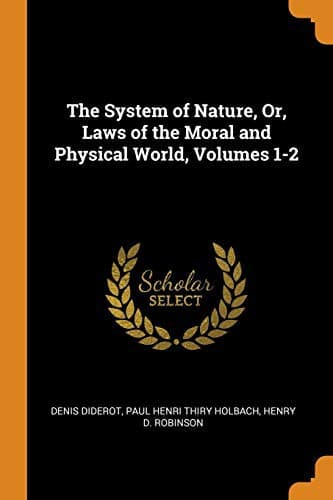
The System of Nature, or, the Laws of the Moral and Physical World. Volume 2Holbach, Paul Henri Thiry, baron d'
Religion
The System of Nature, or, the Laws of the Moral and Physical World. Volume 2
Holbach, Paul Henri Thiry, baron d'
Materialism; Philosophy and religion; Psychology
Atheism, then, as well as philosophy, like all profound abstruse
sciences, is not calculated for the vulgar; neither is it suitable
to the great mass of mankind. There are, in all populous, civilized
nations, persons whose circumstances enable them to devote their time
to meditation, whose easy finances afford them leisure to make deep
researches into the nature of things, who frequently make useful
discoveries, which, sooner or later, after they have been submitted
to the infallible test of experience, when they have passed the fiery
ordeal of truth, extend widely their salutary effects, become extremely
beneficial to society, highly advantageous to individuals. The
geometrician, the chemist, the mechanic, the natural philosopher, the
civilian, the artizan himself, are industriously employed, either
in their closets, or in their workshops, seeking the means to serve
society, each in his sphere: nevertheless, not one of their sciences
or professions are familiar to the illiterate; not one of the arts with
which they are respectively occupied, are known to the uninitiated:
these, however, do not fail, in the long run, to profit by them, to reap
substantive advantages from those labours, of which they themselves have
no idea. It is for the mariner, that the astronomer explores his arduous
science; it is for him the geometrician calculates; for his use the
mechanic plies his craft: it is for the mason, for the carpenter, for
the labourer, that the skilful architect studies his orders, lays down
well-proportioned elaborate plans. Whatever may be the pretended utility
of Pneumatology, whatever may be the vaunted advantages of superstitious
opinions, the wrangling polemic, the subtle theologian, cannot boast
either of toiling, of writing, or of disputing for the advantage of the
people, whom, notwithstanding, he contrives to tax, very exorbitantly,
for those systems they can never understand; from whom he levies the
most oppressive contributions, as a remuneration for the detail of those
mysteries, which under any possible circumstances, cannot, at any time
whatever, be of the slightest benefit to them. It is not, then, for the
multitude that a philosopher should propose to himself, either to write
or to meditate: the Code of Nature, or the principles of atheism, as
the priest calls it, are not, as we have shewn, even calculated for
the meridian of a great number of persons, who are frequently too much
prepossessed in favour of the received prejudices, although extremely
enlightened on other points. It is extremely rare to find men, who, to
an enlarged mind, extensive knowledge, great talents, join either a well
regulated imagination, or the courage necessary to successfully oppugn
habitual errors; triumphantly to attack those chimerical systems, with
which the brain has been inoculated from the first hour of its birth.
A secret bias, an invincible inclination, frequently, in despite of all
Public-domain text, read in full here on John Shaqi.
Reviews
Reviews
No reviews yet
Be the first to share your thoughts on this work.
Elsewhere in the archive
Join the Discussion
Join the discussion
Sign in to leave a comment or review.
Sign InorCreate an account