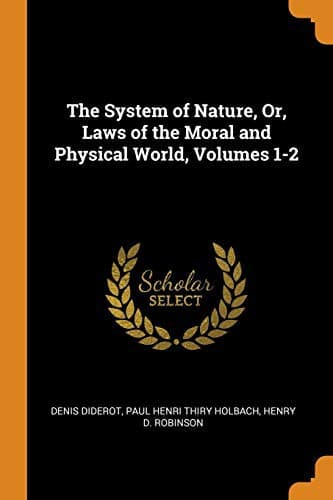
The System of Nature, or, the Laws of the Moral and Physical World. Volume 2Holbach, Paul Henri Thiry, baron d'
Religion
The System of Nature, or, the Laws of the Moral and Physical World. Volume 2
Holbach, Paul Henri Thiry, baron d'
Materialism; Philosophy and religion; Psychology
The theological attributes with which metaphysicians decorated these
divinities, were in fact nothing but pure negations of the qualities
found in man, or in those beings of which he has a knowledge; by these
attributes their gods were supposed exempted from every thing which they
considered weakness or imperfection in him, or in the beings by whom he
is surrounded: they called every quality infinite, which has been
shewn is only to affirm, that unlike man, or the beings with whom he
is acquainted, it is not circumscribed by the limits of space; this,
however, is what he can never in any manner comprehend, because he is
himself finite. Hobbes in his _Leviathan_, says, "whatsoever we imagine
is finite. Therefore there is no idea, or conception of any thing
we call infinite. No man can have in his mind an image of infinite
magnitude, nor conceive infinite swiftness, infinite time, infinite
force, or infinite power. When we say any thing is infinite, we signify
only, that we are not able to conceive the ends and bound of the thing
named, having no conception of the thing, but of our own inability."
Sherlock says, "the word infinite is only a negation, which signifies
that which has neither end, nor limits, nor extent, and, consequently,
that which has no positive and determinate nature, and is therefore
nothing;" he adds, "that nothing but custom has caused this word to
be adopted, which without that, would appear devoid of sense, and a
contradiction."
When it is said these gods are eternal, it signifies they have not had,
like man or like every thing that exists, a beginning, and that they
will never have an end: to say they are immutable, is to say, that
unlike himself or every thing which he sees, they are not subject to
change: to say they are immaterial, is to advance, that their substance
or essence is of a nature not conceivable by himself, but which must
from that very circumstance be totally different from every thing of
which he has cognizance.
It is from the confused collection of these negative qualities, that has
resulted the theological gods; those metaphysical wholes of which it
is impossible for man to form to himself any correct idea. In
these abstract beings every thing is infinity,--immensity,--
spirituality,--omniscience,--order,--wisdom,--intelligence,--
omnipotence. In combining these vague terms, or these modifications, the
ethnic priests believed they formed something, they extended these
qualities by thought, and they imagined they made gods, whilst they only
composed chimeras. They imagined that these perfections or these
qualities must be suitable to their gods, because they were not suitable
to any thing of which they had a knowledge; they believed that
incomprehensible beings must have inconceivable qualities. These were
the materials of which theology availed itself to compose those
inexplicable shadows before which they commanded the human race to bend
the knee.
Public-domain text, read in full here on John Shaqi.
Reviews
Reviews
No reviews yet
Be the first to share your thoughts on this work.
Join the Discussion
Join the discussion
Sign in to leave a comment or review.
Sign InorCreate an account