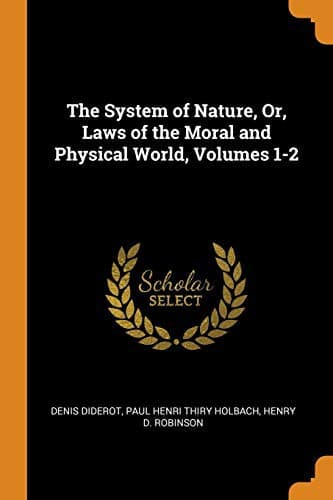
The System of Nature, or, the Laws of the Moral and Physical World. Volume 2Holbach, Paul Henri Thiry, baron d'
Religion
The System of Nature, or, the Laws of the Moral and Physical World. Volume 2
Holbach, Paul Henri Thiry, baron d'
Materialism; Philosophy and religion; Psychology
Nevertheless, experience soon proved that beings so vague, so impossible
to be conceived, so incapable of definition, so far removed from every
thing of which man could have any knowledge, were but little calculated
to fix his restless views; his mind requires to be arrested by qualities
which he is capacitated to ascertain; of which he is in a condition to
form a judgment. Thus after it had subtilized these metaphysical gods,
after it had rendered them so different in idea, from every thing that
acts upon the senses, theology found itself under the necessity of
again assimilating them to man, from whom it had so far removed them: it
therefore again made them human by the moral qualities which it assigned
them; it felt that without this it would not be able to persuade mankind
there could possibly exist any relation between him and such vague,
ethereal, fugitive, incommensurable beings; that it would never be
competent to secure for them his adoration.
It began to perceive that these marvellous gods were only calculated
to exercise the imagination of some few thinkers, whose minds were
accustomed to labour upon chimerical subjects, or to take words for
realities; in short it found, that for the greater number of the
material children of the earth it was necessary to have gods more
analogous to themselves, more sensible, more known to them. In
consequence these divinities were re-clothed with human qualities;
theology never felt the incompatibility of these qualities with beings
it had made essentially different from man, who consequently could
neither have his properties, nor be modified like himself. It did not
see that gods who were immaterial, destitute of corporeal organs, were
neither able to think nor to act as material beings, whose peculiar
organizations render them susceptible of the qualities, the feelings
the will, the virtues, that are found in them. The necessity it felt to
assimilate the gods to their worshippers, to make an affinity
between them, made it pass over without consideration these palpable
contradictions--this want of keeping in their portrait: thus ethnic
theology obstinately continued to unite those incompatible qualities,
that discrepancy of character, which the human mind attempted in vain
either to conceive or to reconcile: according to it, pure spirits were
the movers of the material world; immense beings were enabled to occupy
space, without however excluding nature; immutable deities were the
causes of those continual changes operated in the world: omnipotent
beings did not prevent those evils which were displeasing to them;
the sources of order submitted to confusion: in short, the wonderful
properties of these theological beings every moment contradicted
themselves.
Public-domain text, read in full here on John Shaqi.
Reviews
Reviews
No reviews yet
Be the first to share your thoughts on this work.
Join the Discussion
Join the discussion
Sign in to leave a comment or review.
Sign InorCreate an account