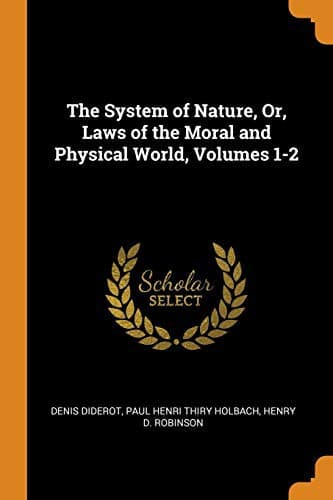
The System of Nature, or, the Laws of the Moral and Physical World. Volume 2Holbach, Paul Henri Thiry, baron d'
Religion
The System of Nature, or, the Laws of the Moral and Physical World. Volume 2
Holbach, Paul Henri Thiry, baron d'
Materialism; Philosophy and religion; Psychology
According to these notions the relations between man and these
theological beings have no existence, they owe nothing to him, are
dispensed from shewing him either goodness or justice; that man, on
the contrary, owes them every thing: but contradictions appear at every
step. If these have promised by their oracles any thing to man, it is
rather difficult for him to believe, that what is so solemnly promised
does not belong to him if he fulfils the condition of the promise.
The difference a theologian may choose to find in these relations will
hardly be convincing to a reasonable mind. The duties of man towards
these beings can, according to their own shewing, have no other
foundation than the happiness he expects from them: thus the relation
has a reciprocity, it is founded upon their goodness, upon their
justice, it demands obedience on his part, a conduct suitable to the
benefits he receives. Thus, in whatever manner the theological system
is viewed, it destroys itself. Will theology never feel that the more
it endeavours to exaggerate the human qualities, the less it exalts the
beings it pictures; the more incomprehensible it renders them, the more
it contributes to swell its own ocean of contradictions; that to take
human passions, mortal faculties at all, is perhaps the worst means it
can pursue to form a perfect being; but that if it must persist in this
method, then the further they remove them from man, the more they debase
him, the more they weaken the relations subsisting between them: that
in thus aggregating human properties, it should carefully abstain from
associating in these pictures those qualities which man finds detestable
in his fellows. Thus, despotism in man is looked upon as an unjust,
unreasonable power; if it introduces such a quality into its portraits,
it cannot rationally suppose them suitable to cultivate the esteem, to
attract the voluntary homage of the human race: if, however, the canvas
be examined, we shall frequently be struck, with perceiving this the
leading feature; we shall equally find a want of keeping through the
whole; that shadows are introduced, where lights ought to prevail; that
the colouring is incongruous--the design without harmony.
Public-domain text, read in full here on John Shaqi.
Reviews
Reviews
No reviews yet
Be the first to share your thoughts on this work.
Elsewhere in the archive
Join the Discussion
Join the discussion
Sign in to leave a comment or review.
Sign InorCreate an account