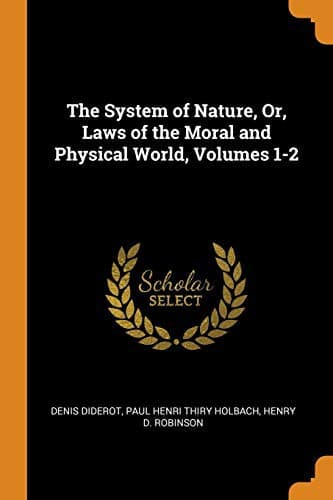
The System of Nature, or, the Laws of the Moral and Physical World. Volume 2Holbach, Paul Henri Thiry, baron d'
Religion
The System of Nature, or, the Laws of the Moral and Physical World. Volume 2
Holbach, Paul Henri Thiry, baron d'
Materialism; Philosophy and religion; Psychology
The Doctor is very little happier in reasoning upon _immateriality_.
He says, by way of illustrating his argument, "that it is possible to
infinite power to create an immaterial cogitative substance, endued
with a power of beginning motion, and with a liberty of will or choice."
Again, "that immaterial substances are not impossible; or, that a
substance immaterial is not a contradictory notion. Now, whoever asserts
that it is contradictory, must affirm that whatever is not matter is
nothing; and that, to say any thing exists which is not matter, is
saying that there exists something which is nothing, which in other
words is plainly this,--that whatever we have not an idea of, is
nothing, and impossible to be." It could, I am apt to believe, never
have entered into any reasonable mind that a thing was impossible
because he could have no idea of it:--many things, on the contrary, are
possible, of which we have not the most slender notion: but it does
not, I presume, flow consecutively out of this admission, that therefore
every thing is, which is not impossible. Doctor Clarke then, rather begs
the question on this occasion. In the schools it is never considered
requisite to prove a negative; indeed, this is ranked by logicians
amongst those things impossible to be, but it is considered of
the highest importance to soundness of argument, to establish the
affirmative by the most conclusive reasoning. Taking this for granted,
we will apply the doctor's own reasoning. He says, "Nothing is that of
which every thing, can truly be affirmed. So that the idea of nothing,
if I may so speak, is absolutely the negative of all ideas; the idea,
therefore, either of a finite or infinite nothing is a contradiction
in terms." To affirm, of a thing with truth, it must be necessary to be
acquainted with that thing. To have ideas, as we have already proved, it
is necessary to have perceptions; to have perceptions, it is requisite
to have sensations; to have sensations, requires organs. An idea cannot
be, and not be, at the same moment: the idea of substance, it will
scarcely be denied, is that of a thing solid, real, according to Dryden;
capable of supporting accidents, according to Watts; something of which
we can say that it is, according to Davies; body, corporeal nature,
according to Newton; the idea of immaterial, according to Hooker, is
incorporeal. How then am I to understand immaterial substance? Is it
not, according to these definitions, that which cannot couple together?
If a thing be immaterial, it cannot be a substance; if a substance, it
cannot be immaterial: those I apprehend will not have many ideas, who do
not see this is a complete negative of all ideas. If, therefore, on the
outset, the doctor cannot find words, by which he can convey the idea of
that of which he is so desirous to prove the existence, by what chain of
reasoning does he flatter himself that he is to be understood? He will
Public-domain text, read in full here on John Shaqi.
Reviews
Reviews
No reviews yet
Be the first to share your thoughts on this work.
Elsewhere in the archive
Join the Discussion
Join the discussion
Sign in to leave a comment or review.
Sign InorCreate an account