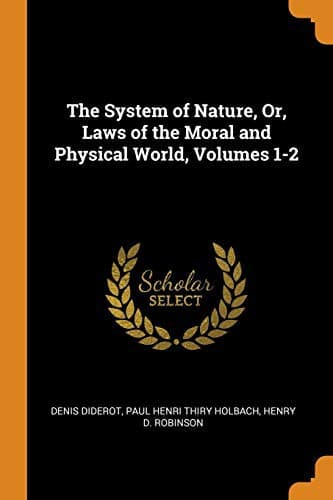
The System of Nature, or, the Laws of the Moral and Physical World. Volume 2Holbach, Paul Henri Thiry, baron d'
Religion
The System of Nature, or, the Laws of the Moral and Physical World. Volume 2
Holbach, Paul Henri Thiry, baron d'
Materialism; Philosophy and religion; Psychology
It is, indeed true, that Plato, who was a great creator of chimeras,
says, "those who admit nothing but what they can see and feel, are
stupid ignorant beings, who refuse to admit the reality of the existence
of invisible things." With all due deference to such an authority, we
may still venture to ask, is there then no difference, no shade, no
gradation, between an admission of possibilities and the proof of
realities. Theology would then be the only science in which it is
permitted to conclude that a thing is, as soon as it is possible to be.
Will the assertion of either Clarke or Plato stand absolutely in place
of all evidence? Would they themselves permit such to be convincing if
used against them? The theologians evidently hold this Platonic, this
dogmatical language; they have dreamed the dreams of their master;
perhaps if they were examined a little, they would be found nothing
more than the result of those obscure notions, those unintelligible
metaphysics, adopted by the Egyptian, Chaldean, and Assyrian priests,
among whom Plato drew up his philosophy. If, however, philosophy means
that which we are led to suppose it does, by the great John Locke, it is
"a system by which natural effects are explained." Taken in this sense
we shall be under the necessity of agreeing, that the Platonic doctrines
in no wise merit this distinction, seeing he has only drawn the human
mind from the contemplation of visible nature, to plunge it into the
unfathomable depths of invisibility--of intangibility--of suppositious
speculation, where it can find little other food except chimeras or
conjecture. Such a philosophy is rather fantastical, yet it would seem
we are required to subscribe to its positions without being allowed
to compare them with reason, to examine them through the medium of
experience, to try the gold by the action of fire: thus we have in
abundance the terms spirits, incorporeal substances, invisible powers,
supernatural effects, innate ideas, mysterious virtues, possessed by
demons, &c. &c. which render our senses entirely useless, which put
to flight every thing like experience; while we are gravely told that
"nothing is that, of which no thing can truly be affirmed." Whoever may
be willing to take the trouble of reading the works of Plato and his
disciples, such as Proclus, Iamblicus, Plotinus, and others, will not
fail to find in them almost every doctrine, every metaphysical
subject of the theologian; in fact, the theurgy of many of the modern
superstitions, which for the most part seems to be little more than a
slight variation of that adopted by the ethnic priests. Dreamers have
not had that variety in their follies, that has generally been imagined.
That some of these things should be extensively admitted, by no means
affords proof of their existence. Nothing appears more facile than to
make mankind admit the greatest absurdities, under the imposing name
of mysteries; after having imbued him from his infancy with maxims
Public-domain text, read in full here on John Shaqi.
Reviews
Reviews
No reviews yet
Be the first to share your thoughts on this work.
Elsewhere in the archive
Join the Discussion
Join the discussion
Sign in to leave a comment or review.
Sign InorCreate an account