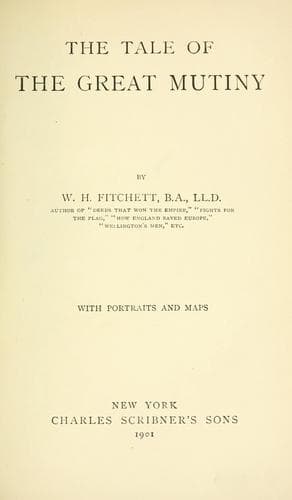
The Tale of the Great MutinyFitchett, W. H. (William Henry)
History
The Tale of the Great Mutiny
Fitchett, W. H. (William Henry)
India -- History -- Sepoy Rebellion, 1857-1858
Almost at the same moment the finest soldier in our battery,
and the best artilleryman I have ever known, Sergeant-Major
Alexander Lamont, had the whole of his stomach carried away
by a round shot. He looked up to me for a moment with a
piteous expression, but had only strength to utter two words,
“Oh! God!” when he sank dead on the road. Just then another
round shot took off the leg, high up the thigh, of the next
senior sergeant, John Kiernan. He was afterwards carried back
to the Alumbagh, but soon died from the shock. Kiernan was
an excellent specimen of a Roman Catholic North of Ireland
soldier. He was as true as steel. Another tragic sight on
that road was the death of a fine young gunner, the only one,
I believe, who wore an artillery jacket that day. A round
shot took his head clean off, and for about a second the body
stood straight up, surmounted by the red collar, and then fell
flat on the road. But as fast as the men of the leading gun
detachments were swept away by the enemy’s fire I replaced
them by volunteers from other guns. Several times I turned to
the calm, cool, grim general standing near, and asked him to
allow us to advance, as we could not possibly do any good by
halting there. He agreed with me, but did not like to take the
responsibility of ordering us to go on.
At last the order to move on came, and Charbagh bridge was reached. It
was defended on the further side by a solid earthen rampart 7ft. high,
but with a narrow slit in the middle through which one man at a time
could pass. It was armed with six guns, two of them 24-pounders. Tall
houses, crowded with musketrymen, covered the bridge with their fire, and
solid battalions were drawn up in its rear. Maude was planted with two
of his guns in the open, and within short range of the enemy’s battery,
and commenced a valiant duel with it. Outram led the 5th Fusileers by
a detour for the purpose of smiting the battery at the bridge-head with
a flank-fire. Maude’s two guns were fighting six, at a distance of 150
yards, and his gunners fell fast.
Again and again he had to call for volunteers to work his guns from the
Madras Fusileers lying down under cover near him. The guns were of an
ancient pattern, and carried a large leathern pouch full of loose powder
for priming uses. “As the lane was very narrow,” says Maude, “the two
guns were exceedingly close to one another, and when in their recoil they
passed each other, amid a shower of sparks and smoke, they frequently
set fire to the loose powder in the priming pouches, and blew the poor
gunners up!” Yet Maude’s gallant lads worked their guns unflinchingly.
Public-domain text, read in full here on John Shaqi.
Reviews
Reviews
No reviews yet
Be the first to share your thoughts on this work.
Elsewhere in the archive
Join the Discussion
Join the discussion
Sign in to leave a comment or review.
Sign InorCreate an account