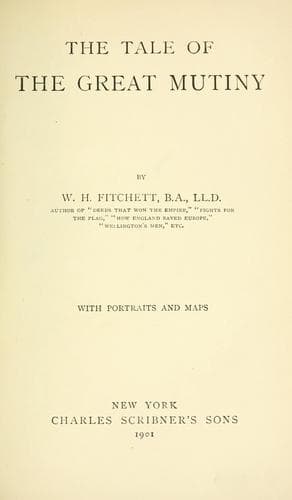
The Tale of the Great MutinyFitchett, W. H. (William Henry)
History
The Tale of the Great Mutiny
Fitchett, W. H. (William Henry)
India -- History -- Sepoy Rebellion, 1857-1858
The Sepoys next brought up three brass guns, and lashed temple and road
alike with their fire. Webster, an officer of the 78th, famous for his
swordsmanship and strength, called out, “Who’s for these infernal guns?”
and ran out, sword in hand. His Highlanders followed him, but could not
overtake Webster, who sprang upon the guns, and slew a gunner, just in
the act of putting his linstock to the touch-hole, with a stroke so
mighty that it clove the Sepoy through skull and jaws almost to the
collar-bone! The guns were captured, dragged with a triumphant skirl
of the pipes to the canal, and flung in, and the Highlanders set off to
follow the column.
They did not follow in its immediate track, but made a wide sweep to the
right, and both sections of the column, with much stern fighting, reached
what was called the Chutter Munzil Palace. “Here,” says Forbes, “were the
chiefs of the little army. On his big ‘waler’ sat Outram, a splash of
blood across his face, and one arm in a sling, the Malacca cane, which
formed his sole weapon in battle, still grasped in the hand of the sound
limb. Havelock, on foot, was walking up and down on Outram’s near side,
with short steps. All around them, at a little distance, were officers,
and outside of the circle so formed were soldiers, guns, wounded men,
bullocks, camels”—all the tumult, in a word, of the battle.
Outram and Havelock disagreed as to the next step to be taken. Outram—the
cooler brain of the two—wished to halt for the night, and then to push
their way in the morning through the successive courts of the palaces
right up to the Residency. Havelock was eager to complete the day’s work,
and reach the Residency with a final and desperate rush.
A long, winding, and narrow street stretched before them up to the Bailey
Guard Gate, the entrance to the Residency. It was true that every cross
street that broke its length was swept by the fire of the enemy’s guns,
that the houses were loopholed and crowded with Sepoys, and from the
flat roofs of the houses above a tempest of fire would be poured upon
the British. But Havelock was full of warlike impatience. “There is the
street,” said he; “we see the worst. We shall be slated, but we can push
through, and get it over.” Outram acknowledged afterwards that he ought
to have said, “Havelock, we have virtually reached the Residency. I now
take the command;” but he added to the confession, “My temper got a
little the better of me, and I said, ‘In God’s name, then, let us go on.’”
The Highlanders led, Havelock and Outram riding with their leading
files. Brasyer’s Sikhs followed. It was, as Forbes says, “a true _via
dolorosa_.” From house-roof, from door, from window, from every cross
lane poured a tempest of shot, and through it the British could only push
with dogged, all-enduring courage, seldom halting to fire back. And this
experience stretched over more than three-quarters of a mile! Here is a
little battle vignette taken from Forbes:—
Public-domain text, read in full here on John Shaqi.
Reviews
Reviews
No reviews yet
Be the first to share your thoughts on this work.
Elsewhere in the archive
Join the Discussion
Join the discussion
Sign in to leave a comment or review.
Sign InorCreate an account