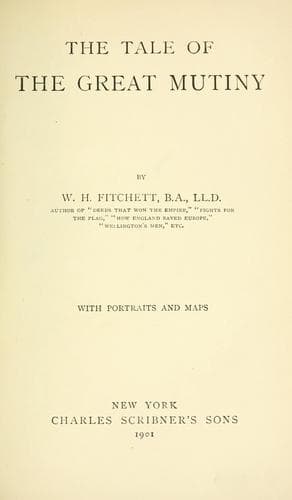
The Tale of the Great MutinyFitchett, W. H. (William Henry)
History
The Tale of the Great Mutiny
Fitchett, W. H. (William Henry)
India -- History -- Sepoy Rebellion, 1857-1858
On the afternoon of November 11 Campbell reviewed the relieving force
at Buntera. It was modest in numbers—counting only about 4700 men.
But war-hardened, and full of fiery yet disciplined daring, it was as
efficient for all the purposes of battle as Napoleon’s Old Guard or
Wellington’s famous Light Division. The cavalry brigade included two
squadrons of the 9th Lancers, Hodson’s Horse, and three squadrons of
native cavalry. The Naval Brigade was under Peel, the third son of the
great Prime Minister of England, one of the most daring yet gentle
spirits that ever fought and died for England. Evelyn Wood, who served
under him as middy in the Crimea, describes him as “the bravest of the
brave,” and yet “an ideal English gentleman.” “His dark brown wavy hair
was carefully brushed back, disclosing a perfectly oval face, a high
square forehead, and deep blue-grey eyes, which flashed when he was
talking eagerly, as he often did.” The Artillery Brigade consisted of
five batteries. The infantry was made up of detachments from the 4th, the
5th, the 23rd Fusileers, a wing of the 53rd, part of the 82nd, and the
full strength of the 93rd Highlanders, with some Sikh regiments.
The 93rd was 1000 strong, and 700 men in the ranks carried the Crimean
medal on their breasts. It has been described as “the most Scotch of
all the Highland regiments,” and a strong religious—as well as a rich
Celtic—strain ran through its ranks. Forbes-Mitchell, indeed, who
marched in its ranks, says the regiment constituted a sort of military
Highland parish, ministers and elders complete. The elders were selected
from among the men of all ranks, two sergeants, two corporals, and two
privates. It had a regular service of communion plate, and the communion
was administered to the whole regiment by its chaplain twice a year.
The 93rd was drawn up in quarter-distance column on the extreme left of
the line as Colin Campbell rode down to review his forces that November
afternoon. It was in full Highland costume, with kilts and bonnets and
wind-blown plumes. Campbell’s Celtic blood kindled when he reached the
Highlanders. “Ninety-third!” he said, “you are my own lads; I rely on you
to do the work.” And a voice from the ranks in broadest Doric answered,
“Ay, ay, Sir Colin, ye ken us and we ken you; we’ll bring the women and
children out of Lucknow or die wi’ you in the attempt.” And then from
the steady ranks of the Highlanders there broke a shout, sudden and deep
and stern, the shout of valiant men—the men of the hardy North—pledging
themselves to valiant deeds.
Here is the description given by an eye-witness of the little army, less
than 5000 strong, but of such magnificent fighting quality, down whose
ranks Colin Campbell rode as the November sun was going down:—
Public-domain text, read in full here on John Shaqi.
Reviews
Reviews
No reviews yet
Be the first to share your thoughts on this work.
Elsewhere in the archive
Join the Discussion
Join the discussion
Sign in to leave a comment or review.
Sign InorCreate an account