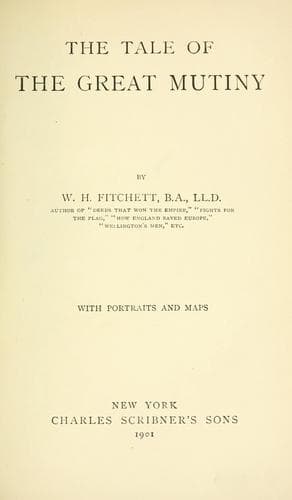
The Tale of the Great MutinyFitchett, W. H. (William Henry)
History
The Tale of the Great Mutiny
Fitchett, W. H. (William Henry)
India -- History -- Sepoy Rebellion, 1857-1858
Young Roberts, with Captain Norman, accompanied Outram and Havelock
back to the Residency, and he has described how he passed from post to
post, held with such long-enduring and stubborn courage by the relieved
garrison. “When we came,” he says, “to the Bailey Guard, and looked at
the battered walls and gateway, not an inch without a mark of a round
shot or bullet, we marvelled that Aitken and Loughnan could have managed
to defend it for nearly five months.” It was found difficult to get the
relieved garrison to talk of their own experiences; they were too hungry
for news from the outside world! Jones-Parry says, “The first man of
the garrison I met was my old schoolfellow and chum, Meecham. He was an
excellent specimen of the condition of the defenders, for he looked more
like a greyhound than a man. He was thin as a lath, and his eyes looked
sunken into his head.”
Lucknow was relieved; but to reach the Residency had cost Sir Colin
Campbell a loss of 45 officers and 496 men. Campbell found his position
difficult. He had broken through the besieging force; he had not ended
the siege. To hold the Residency meant to be besieged himself. He decided
to bring off the Residency garrison, with the women and children,
abandoning the shot-wrecked walls and foul trenches to the enemy. To
evacuate the Residency, carrying off in safety, through the lines of a
hostile force five times as numerous as his own, 600 women and children,
and more than 1000 sick or wounded men, was a great feat, but Sir Colin
Campbell accomplished it, and did it so adroitly that not a casualty was
incurred, and not a serviceable gun abandoned. So completely, in fact,
did Sir Colin Campbell deceive the enemy that their guns were pouring
their fire angrily on the Residency for at least four hours after the
last British soldier had left it!
Havelock died just as he was being carried out of the slender and
battered defences he had reached and held so gallantly. He died of an
attack of dysentery, brought on, says Major Anson, “by running nearly
three-quarters of a mile under fire from the Residency to meet the
Commander-in-Chief and greet him as his deliverer.”
He lies buried in the Alumbagh, the place Havelock himself won by an
assault so daring when advancing to relieve Lucknow. He was buried on
the morning of November 25, and round his rude coffin, on which the
battle-flag lay, stood his sorrowing comrades, a group of the most
gallant soldiers that earthly battlefields have ever known—Campbell, and
Outram, and Peel, and Adrian Hope, and Fraser Tytler, and the younger
Havelock, with men of the Ross-shire Buffs and of the Madras Fusileers,
whom Havelock had so often led to victory. On a tree that grew beside the
grave the letter H was roughly carved, to mark where Havelock’s body lay.
To-day the interior of the Alumbagh is a garden, and a shapely obelisk
marks the spot where sleeps the dust of one of the bravest soldiers that
ever fought for the honour and flag of England.
Public-domain text, read in full here on John Shaqi.
Reviews
Reviews
No reviews yet
Be the first to share your thoughts on this work.
Elsewhere in the archive
Join the Discussion
Join the discussion
Sign in to leave a comment or review.
Sign InorCreate an account