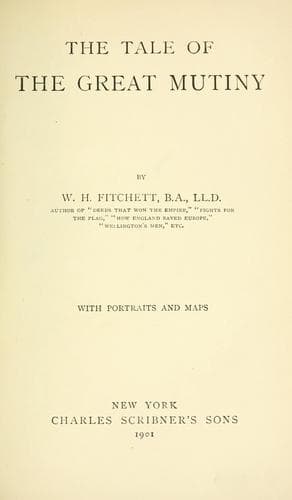
The Tale of the Great MutinyFitchett, W. H. (William Henry)
History
The Tale of the Great Mutiny
Fitchett, W. H. (William Henry)
India -- History -- Sepoy Rebellion, 1857-1858
Windham was a soldier of a fine, if not of the highest type, a man of
immense energy and of cool daring which, if it always saw the peril,
scorned to turn aside on account of it. His sobriquet was “Redan”
Windham, and no one who has read the story of how, on September 8, 1855,
he led the British stormers through the embrasures of the Redan can doubt
that Windham’s courage was of a lion-like quality. He was the first of
the stormers of the Second Division to cross the great ditch in front
of the Redan, and the first to clamber through an embrasure. When his
men—young soldiers belonging to half-a-dozen separate regiments—hung back
under the great ramparts of the Redan, Windham thrice ran forward alone
with his brandished sword into the centre of the work, calling on the men
to follow. He has told the story of how, again and again, he went back to
his men, patted them on the back, and begged them to follow him.
Five times he sent to the rear for reinforcements, and it shows the
coolness of the man in the hell of that great fight that, determined at
last to go himself in search of additional troops, he first turned to an
officer standing near and asked his name. Then he said to him, “I have
sent five times for support, now bear witness that I am not in a funk”—at
which the officer smiled—“but I will now go back myself and see what I
can do.”
He went back, but before he could bring up new troops, the men still
clinging to the Redan gave way, and the attack failed. Windham’s judgment
was challenged, but he was as brave as his own sword. He no doubt had his
limitations as an officer. Russell, a perfectly good critic, says that he
“seemed always to have something to do in addition to something that he
had done already.” There was a certain note of hurry in his character,
that is, which does not add to the efficiency of a leader. His failing
as an officer, Russell adds, was “reckless gallantry and dash”—grave
faults, no doubt, in a general, but faults which are not without their
compensations in a mere leader of fighting men. This was the man whom
Campbell chose to keep the bridge at Cawnpore while he made his dash for
the relief of Lucknow.
Windham’s force consisted of 500 men, made up of convalescent
artillerymen, some sailors, and four companies of the 64th. Some
earthworks had been thrown up to guard the bridge-head, but, in a
military sense, the position was scarcely defensible. Windham’s orders
were to forward with the utmost speed to Campbell all reinforcements as
they came up; to keep a vigilant watch on the Gwalior contingent, and
hold the bridge to his last man and the last cartridge.
Public-domain text, read in full here on John Shaqi.
Reviews
Reviews
No reviews yet
Be the first to share your thoughts on this work.
Elsewhere in the archive
Join the Discussion
Join the discussion
Sign in to leave a comment or review.
Sign InorCreate an account