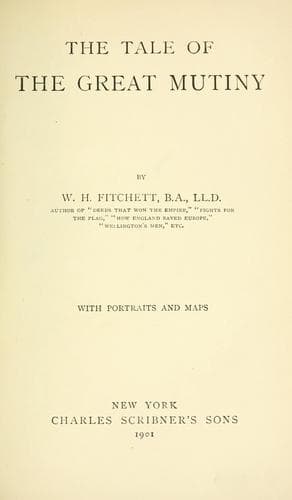
The Tale of the Great MutinyFitchett, W. H. (William Henry)
History
The Tale of the Great Mutiny
Fitchett, W. H. (William Henry)
India -- History -- Sepoy Rebellion, 1857-1858
Windham was out-generalled, and had no choice but to fall back on his
entrenchments, and he had to do this through narrow streets and broken
ground while attacked in front and on both flanks by a victorious enemy
ten times stronger than himself in bayonets, and more than ten times
stronger in artillery. Adye says that the retreat to the entrenchments
“was made in perfect order, and not a man was lost in the operation”;
but on this subject there is the wildest conflict of evidence. Moore,
the chaplain of Windham’s force, says “the men got quite out of hand,
and fled pell-mell for the fort. An old Sikh officer at the gate tried
to stop them and to form them up in some order, and when they pushed
him aside and brushed past him he lifted up his hands and said, ‘You
are not the brothers of the men who beat the Khalsa army and conquered
the Punjab!’” Mr. Moore goes on to say that “the old Sikh followed the
flying men through the fort gate, and, patting some of them on the back,
said, ‘Don’t run, don’t be afraid; there is nothing to hurt you.’” If
there was disorder the excuse is that the men were, for the most part,
young soldiers without regimental cohesion—they were mere fragments of
half-a-dozen regiments—they had been for five hours under an overwhelming
artillery fire, and were exhausted with want of food: and a retreat under
such conditions, and through a hostile city, might well have taxed the
steadiness of the best troops in the world. As a matter of fact, the men
of the 64th, the 34th, and the 82nd held together with the steadiness
of veterans, and their slow and stubborn retreat, their fierce volleys
and occasional dashes with the bayonets, quite cooled the ardour of the
mutineers as they followed the retreating British.
At one point, indeed, on the right flank of the British there was a clear
case of misconduct, and the culprit was an officer. His name in all the
published reports is concealed under the charity of asterisks. Campbell,
in his despatch, says:—“Lieut.-Colonel * * * misconducted himself on the
26th and 27th November in a manner which has rarely been seen amongst
the officers of Her Majesty’s service; his conduct was pusillanimous and
imbecile to the last degree, and he actually gave orders for the retreat
of his own regiment, and a portion of another, in the very face of the
orders of his General, and when the troops were not seriously pressed by
the enemy.”
Every man who wears a red coat and a pair of epaulettes is not
necessarily a hero, and human courage, at best, is a somewhat unstable
element. This particular officer had risen to high rank and seen much
service, but some failure of nerve, some sudden clouding of brain, in the
stress of that desperate fight, made him play—if only for a moment—the
part both of an imbecile and a coward, and surrender a position which was
essential to the British defence. He was court-martialled after the fight
and dismissed the service.
Public-domain text, read in full here on John Shaqi.
Reviews
Reviews
No reviews yet
Be the first to share your thoughts on this work.
Elsewhere in the archive
Join the Discussion
Join the discussion
Sign in to leave a comment or review.
Sign InorCreate an account