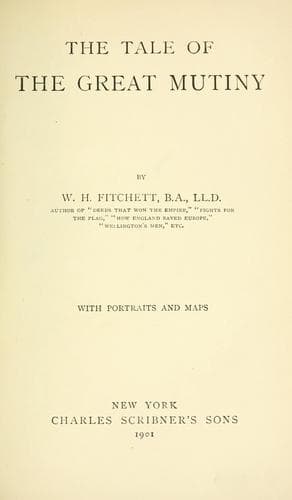
The Tale of the Great MutinyFitchett, W. H. (William Henry)
History
The Tale of the Great Mutiny
Fitchett, W. H. (William Henry)
India -- History -- Sepoy Rebellion, 1857-1858
Peel’s heavy guns were swung round, and opened in fierce duel with the
enemy’s battery firing on the bridge. One of the first shots fired from
one of Peel’s 24-pounders struck the gun which Nana Sahib had at last got
to bear upon the bridge, and dismounted it. An 8-inch shell next dropped
amongst a crowd of his troops, and they quickly fell back. Then the
British troops commenced to file across the river, still under the fire
of the enemy. The enemy’s advance batteries were quickly driven back, and
the great convoy began to creep over the bridge.
For thirty-six hours the long procession of sick and wounded, of women
and children, of guns and baggage crept across the swaying bridge. On
the night of the 29th, the mutineers tried to interrupt the process by
sending down fire-rafts upon the bridge. Tried earlier, the scheme might
have succeeded, or tried even then with greater skill and daring, it
might have had some chance of success; as it was, it failed ignobly,
and the endless stream of non-combatants was brought over the river
into safety. Campbell, for all his fire of courage—and it may be
added of temper—had an ample measure of Scottish coolness, and he kept
quietly within his lines for five days till his helpless convoy had been
despatched under escort to Allahabad, and was beyond reach of hostile
attack. Then, with his force in perfect fighting form, he addressed
himself to the task of crushing the enemy opposed to him.
His own force, steadily fed by reinforcements, by this time numbered
5000 infantry, 600 sailors, and 35 guns; that of the enemy amounted
to something like 25,000 men with 40 guns. Nana Sahib, with his mass
of somewhat irregular troops, occupied the left wing between the city
and the river; the Gwalior contingent, still formidable in numbers and
military efficiency, occupied the town as a centre, and formed the
enemy’s right wing, thrust out into the plain towards the canal. It was
a very strong position. The enemy’s left, perched on high wooded hills,
was covered with nullahs and scattered buildings. An attack on their
centre could only be made through the narrow and crooked streets of the
city, and was therefore almost impossible. But their right lay open to
Campbell’s stroke, and if turned it would be thrust off the Calpee road,
its only line of retreat.
Public-domain text, read in full here on John Shaqi.
Reviews
Reviews
No reviews yet
Be the first to share your thoughts on this work.
Elsewhere in the archive
Join the Discussion
Join the discussion
Sign in to leave a comment or review.
Sign InorCreate an account