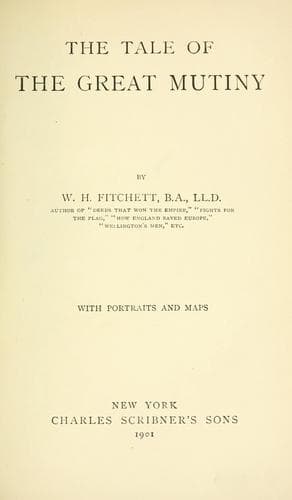
The Tale of the Great MutinyFitchett, W. H. (William Henry)
History
The Tale of the Great Mutiny
Fitchett, W. H. (William Henry)
India -- History -- Sepoy Rebellion, 1857-1858
Undetected in the sheltering blackness, the column reached the sleeping
battery. A startled Sepoy, who caught through the haze and shadow a
sudden glimpse of stern faces and the gleam of bayonets, gave a hasty
challenge. It was answered by a volley which ran like a streak of jagged
flame through the darkness, and with a rush the British—their officers
gallantly leading, and Sikh and Ghoorka trying to outrace their English
comrades—swept on to the battery. The Sepoys succeeded in discharging two
guns on their assailants; but Lord Roberts records that the discharge of
the third gun was prevented by a gallant Irish soldier named Reegan.
He leaped with levelled bayonet over the earthwork, and charged the
artilleryman, who was in the very act of thrusting his port-fire on to
the powder in the touch-hole of the gun. Reegan was struck at on every
side, but nothing stopped him, and the fierce lunge of his bayonet
slew the artilleryman and prevented the discharge of the gun. Captain
Greville, followed by two or three men, flung himself on another gun, and
slew or drove off its gunners.
Hodson characteristically says, “It was a very comfortable little
affair!” As a matter of fact, it was, for a dozen fierce minutes, a
deadly hand-to-hand combat. “The rebel artillerymen,” says Roberts,
“stood to their guns splendidly, and fought till they were all killed.”
The rebels, too, were in great force, and as the passionate _mêlée_
swayed to and fro, and the muskets crackled fiercely, and angry thrust
of bayonet was answered by desperate stroke of tulwar, the slaughter
was great. Some 250 Sepoys were slain, while the British only lost one
officer and nineteen men, though nearly a hundred more were wounded. But
the battery was destroyed, and four guns brought back in triumph to the
camp.
The return of the force was a scene of mad excitement. A wounded
officer sat astride one gun, waving his hand in triumph. A soldier,
with musket and bayonet fixed, bestrode each horse, and dozens of
shouting infantrymen—many with wounds and torn uniform, and all with
smoke-blackened faces—clung, madly cheering, to the captured pieces.
On August 7 there rode into the British camp perhaps the most famous
and daring soldier in all India, the man with whose memory the siege
of Delhi, and the great assault which ended the siege, are for ever
associated—John Nicholson.
Public-domain text, read in full here on John Shaqi.
Reviews
Reviews
No reviews yet
Be the first to share your thoughts on this work.
Elsewhere in the archive
Join the Discussion
Join the discussion
Sign in to leave a comment or review.
Sign InorCreate an account