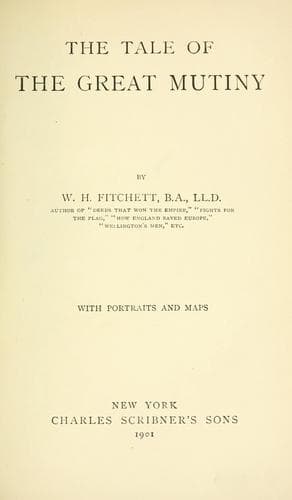
The Tale of the Great MutinyFitchett, W. H. (William Henry)
History
The Tale of the Great Mutiny
Fitchett, W. H. (William Henry)
India -- History -- Sepoy Rebellion, 1857-1858
What was Nicholson’s fighting quality, indeed, may be judged, say,
from the fashion in which he smashed up the mutinous Sepoys at Mardan
(as told in Trotter’s “Life” of him), and chased them mile after mile
towards the hills of Swat, Nicholson leading the pursuit on his huge grey
charger, “his great sword felling a Sepoy at every stroke!” His faculty
for strategy, and for swift, sustained movement is, again, told by the
manner in which he intercepted and destroyed the Sealkote mutineers at
the fords of the Ravi on their way to Delhi, The mutineers were two days’
march ahead of him, and Nicholson made a forced march of forty-four miles
in a single day, and under a July sun in India, to get within stroke of
them. Nicholson’s little force started at 9 P.M. on July 10, and marched
twenty-six miles without a break; after a halt of two hours they started
on their second stage of eighteen miles at 10 A.M. During the hottest
hour of the afternoon the force camped in a grove of trees, and the men
fell, exhausted, into instant slumber.
Presently an officer, awakening, looked round for his general. “He saw
Nicholson,” says Trotter, “in the middle of the hot, dusty road, sitting
bolt upright on his horse in the full glare of that July sun, waiting
like a sentinel turned to stone for the moment when his men should resume
their march!” They might take shelter from the heat, but he scorned it.
A march so swift and fierce was followed by an attack equally vehement,
Nicholson leading the rush on the enemy’s guns in person, and with his
own sword cutting literally in two a rebel gunner in the very act of
putting his linstock to the touch-hole of his cannon.
The worship of force is natural to the Eastern mind; and, in 1848, when
Nicholson was scouring the country between the Attock and the Jhelum,
making incredible marches, and shattering with almost incredible valour
whole armies with a mere handful of troops, the mingled admiration and
dread of the native mind rose to the pieties of a religion. “To this
day,” a border chief told Younghusband, twelve years after Nicholson
was dead, “our women at night wake trembling, and saying they hear the
tramp of Nikalsain’s war-horse!” A brotherhood of Fakirs renounced all
other creeds, and devoted themselves to the worship of “Nikkul-Seyn.”
They would lie in wait for Nicholson, and fall at his feet with votive
offerings.
Public-domain text, read in full here on John Shaqi.
Reviews
Reviews
No reviews yet
Be the first to share your thoughts on this work.
Elsewhere in the archive
Join the Discussion
Join the discussion
Sign in to leave a comment or review.
Sign InorCreate an account