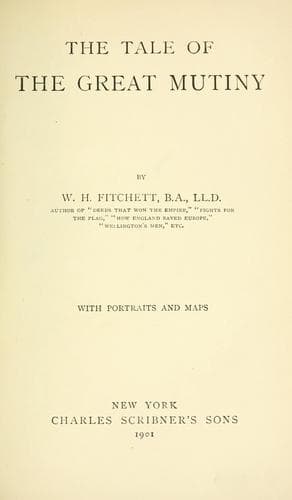
The Tale of the Great MutinyFitchett, W. H. (William Henry)
History
The Tale of the Great Mutiny
Fitchett, W. H. (William Henry)
India -- History -- Sepoy Rebellion, 1857-1858
There was treachery, too, in Wilson’s scanty force. Their plans were
betrayed to the enemy. The slaughter amongst the British officers in the
native regiments was such as could only be explained by the fact that
they were shot down by their own men from behind, rather than by their
open foes in the front. The one good service General Reed did during his
brief interval of command was to dismiss from the camp some suspected
regiments.
Archdale Wilson’s nerve, like that of Barnard and of Reed, his
predecessors, was shaken by the terrific strain of the siege, and he
contemplated abandoning it. “Wilson’s head is going,” wrote Nicholson to
Lawrence on September 7; “he says so himself, and it is quite evident
he speaks the truth.” It was due chiefly to John Lawrence’s clear
judgment and iron strength of will that a step so evil and perilous was
not taken. Lawrence had flung his last coin, his last cartridge, his
last man into the siege, and he warned Wilson that the whole fate of
the British in India depended on an immediate assault. “Every day,” he
wrote, “disaffection and mutiny spread. Every day adds to the danger of
the native princes taking part against us.” The loyalty of the Sikhs
themselves was strained to the breaking point. Had the British flag
fallen back from the Ridge, not merely would Delhi have poured out its
armed host, 50,000 strong, but every village in the north-west would have
risen, and the tragedy of the Khyber Pass might have been repeated, on a
vaster scale, upon the plains of Hindustan. The banks of the Jumna might
have seen such a spectacle as Cabul once witnessed.
But there were brave men on the Ridge itself, trained in Lawrence’s
school, and in whom the spirit of John Lawrence burned with clear and
steady flame. Baird Smith and Neville Chamberlain, Norman and Nicholson,
and many another, knew that the fortunes and honour of England hung on
the capture of Delhi. Lord Roberts tells a curious and wild story that
shows what was Nicholson’s temper at this crisis:—
Public-domain text, read in full here on John Shaqi.
Reviews
Reviews
No reviews yet
Be the first to share your thoughts on this work.
Elsewhere in the archive
Join the Discussion
Join the discussion
Sign in to leave a comment or review.
Sign InorCreate an account