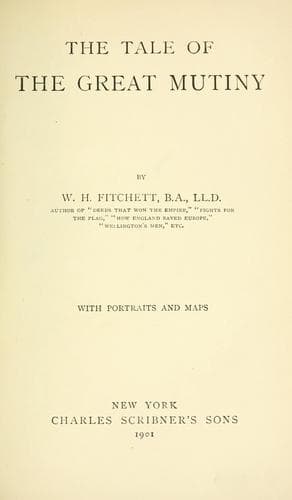
The Tale of the Great MutinyFitchett, W. H. (William Henry)
History
The Tale of the Great Mutiny
Fitchett, W. H. (William Henry)
India -- History -- Sepoy Rebellion, 1857-1858
I dismounted to see if I could be of any use to the occupant,
when I found, to my grief and consternation, that it was John
Nicholson, with death written on his face. He told me that the
bearers had put the doolie down and had gone off to plunder;
that he was in great pain, and wished to be taken to the
hospital. He was lying on his back, no wound was visible, and
but for the pallor of his face, always colourless, there was no
sign of the agony he must have been enduring. On my expressing
a hope that he was not seriously wounded, he said, “I am dying;
there is no chance for me.” The sight of that great man lying
helpless and on the point of death was almost more than I could
bear. Other men had daily died around me, friends and comrades
had been killed beside me, but I never felt as I felt then—to
lose Nicholson seemed to me at that moment to lose everything.
Nicholson’s fall, it is striking to note, impressed every one in that
tiny and heroic army at Delhi exactly as it impressed Roberts. He
lingered through all the days of slow, stubborn, resolute fighting, which
won Delhi; but day by day the news about Nicholson’s fluctuating life
was almost more important than the tidings that this position or that
had been carried. Nicholson was a man with Clive’s genius for battle
and mastery over men, while in the qualities of chivalry and honour he
deserved to be classed with Outram or Havelock. He was only thirty-seven
when he died; what fame he might have won, had he lived, no man can tell.
He was certainly one of the greatest soldiers the English-speaking race
has produced.
Many monuments have been erected to Nicholson; one over his actual grave,
another—with an unfortunately elaborate inscription—in the parish church
at Lisburn. But the fittest and most impressive monument is a plain
obelisk erected on the crest of the Margalla Pass, the scene, in 1848, of
one of his most daring exploits. There in the wild border pass stands the
great stone pillar, and round it still gathers many a native tradition of
the daring and might of the great sahib. Sir Donald Macnab says that when
the worshippers of “Nikkul-Seyn” in Hazara heard of his death, “they came
together to lament, and one of them stood forth and said there was no
gain from living in a world that no longer held Nikalsain. So he cut his
throat deliberately and died.” The others, however, reflected that this
was not the way to serve their great guru; they must learn to worship
“Nikalsain’s God”; and the entire sect actually accepted Christianity on
the evidence of Nicholson’s personality!
Public-domain text, read in full here on John Shaqi.
Reviews
Reviews
No reviews yet
Be the first to share your thoughts on this work.
Elsewhere in the archive
Join the Discussion
Join the discussion
Sign in to leave a comment or review.
Sign InorCreate an account