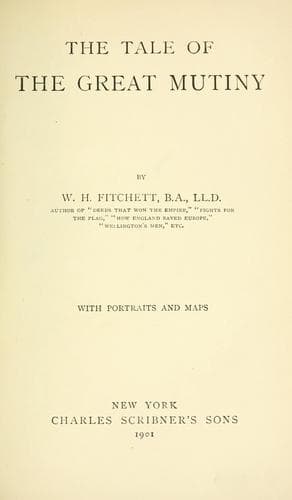
The Tale of the Great MutinyFitchett, W. H. (William Henry)
History
The Tale of the Great Mutiny
Fitchett, W. H. (William Henry)
India -- History -- Sepoy Rebellion, 1857-1858
Hope Grant, for example, records that a sentry was found at one of the
palace gates dressed and equipped according to regulation, and marching
up and down on his beat with his musket on his shoulder. “In a museum
at Naples,” he adds, “is to be seen the skull and helmet of a man who
was found buried at his post in a sentry-box in the midst of the lava.
The inscription states the occupant to have been a ‘brave soldier’; but
nothing could have been braver or cooler than the conduct of this Sepoy,
who must have known that his fate was sealed.” Roberts, who shared in
the rush for the palace gates, adds another curious example of Sepoy
courage. They found the recesses in the long passage which led to the
palace buildings packed with wounded men, but about thirty yards up the
passage stood a Sepoy in the uniform of a grenadier of the 37th Native
Infantry. The man stood quietly as the British came along the passage,
with his musket on his hip. Then he coolly raised his musket and fired
at the advancing party, sending his bullet through the helmet of the
leading Englishman. Next, dropping his musket to the level, he charged
single-handed down on the entire detachment of the 60th, and was killed!
Colonel Jones, who commanded the Rifles, sent a pencilled note to Wilson
announcing, with soldier-like brevity, “Blown open the gate and got
possession of the palace.”
At sunrise on the morning of September 21 a royal salute rang over Delhi,
its pulses of deep sound proclaiming to all India that the sacred city,
the home and stronghold of the revolt, was once more in British hands.
That same day Wilson moved in from his rough camp on the Ridge, and
established his headquarters in the Dewan-i-khas, the king’s private hall
of audience.
But if Delhi was captured, the King of Delhi, with all the leading
figures in the Mutiny, yet remained free, and might easily become the
centre of new troubles. The rebel commander-in-chief felt that the game
was up when the Burn Bastion was carried, and he fled from the city
that night, carrying with him most of his troops. He urged the king to
flee with him, and to renew the war in the open country, where his name
would have all the magical charm of a spell on the imagination of the
common people. But the unhappy king was old and tired. His nerve had been
dissolved in the sloth and sensualities of an Indian court. His favourite
wife strongly opposed flight, in the interests of her child, whom she
hoped to see succeeding the king.
The unhappy monarch, in a word, could neither flee nor stay, and he took
refuge in a stately cluster of famous buildings named Humayon’s Tomb,
some seven miles out of Delhi. Hodson, the daring and famous captain
of Light Horse, ascertained this, and with some trouble extracted from
Wilson permission to attempt the capture of the king, with strict
instructions to promise him his life. Taking fifty picked men from his
regiment, Hodson rode out on one of the most audacious expeditions ever
undertaken.
Public-domain text, read in full here on John Shaqi.
Reviews
Reviews
No reviews yet
Be the first to share your thoughts on this work.
Elsewhere in the archive
Join the Discussion
Join the discussion
Sign in to leave a comment or review.
Sign InorCreate an account