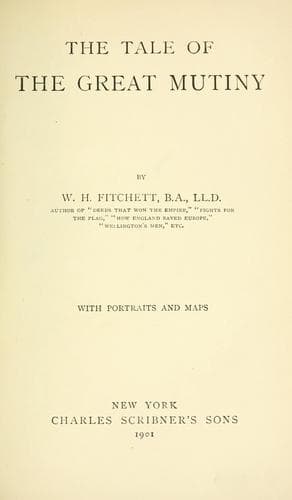
The Tale of the Great MutinyFitchett, W. H. (William Henry)
History
The Tale of the Great Mutiny
Fitchett, W. H. (William Henry)
India -- History -- Sepoy Rebellion, 1857-1858
He was an old man, said by one of the servants to be ninety
years of age, short in stature, slight, very fair for a native,
and with a high-bred, delicate-looking cast of features. Truly
the dignity had departed from the Great Mogul, whose ancestors
had once been lords of princely possessions in India. It might
have been supposed that death would have been preferable to
such humiliation, but it is wonderful how we all cling to the
shreds of life. When I saw the poor old man he was seated on a
wretched charpoy, or native bed, with his legs crossed before
him, and swinging his body backwards and forwards with an
unconscious dreamy look. I asked him one or two questions, and
was surprised to hear an unpleasantly vulgar voice answering
from behind a small screen. I was told that this proceeded from
his begum, or queen, who prevented him from replying, fearful
lest he might say something which should compromise their
safety.
Sir Richard Temple, who prepared the evidence for the trial of the
ex-king of Delhi, paid many visits to the ill-fated monarch during
his confinement. “It was a strange sight,” he says, “to see the aged
man, seated in a darkened chamber of his palace; the finely chiselled
features, arched eyebrows, aquiline profile, the sickly pallor of the
olive complexion, nervous twitching of the face, delicate fingers
counting beads, muttering speech, incoherent language, irritable
self-consciousness—altogether made up a curious picture. Here sat the
last of the Great Moguls, the descendant of emperors two centuries ago
ruling the second largest population in the world; who had himself,
though a phantom sovereign, been treated with regal honours. He was now
about to be tried for his life by judges whose forefathers had sued for
favour and protection from his imperial ancestors.”
But there still remained uncaptured the two sons and the grandson of
the king. The princes had a very evil fame. They had tortured and
slain English prisoners. They had been the leading figures in the
Mutiny. Their hands were red with innocent blood, the blood of little
children and of helpless women. The princes—Mirza Mogul, at one time the
commander-in-chief of the rebel forces, Mirza Khejoo Sultan, and Mirza
Aboo Bukir, the son of the late heir-apparent—with some 6000 or 7000
followers, had occupied Humayon’s Tomb after the king’s capture, partly
in a mood of fatalistic despair, and partly with the expectation that
they might find the same mercy the king had found.
Macdowell, who was second in command of Hodson’s Horse, tells how, on
September 21, he got a note from Hodson, “Come sharp; bring 100 men.”
He rode off at once, and, on meeting, Hodson explained that he had
ascertained that the three princes were in Humayon’s Tomb, and he meant
to bring them in.
Public-domain text, read in full here on John Shaqi.
Reviews
Reviews
No reviews yet
Be the first to share your thoughts on this work.
Elsewhere in the archive
Join the Discussion
Join the discussion
Sign in to leave a comment or review.
Sign InorCreate an account