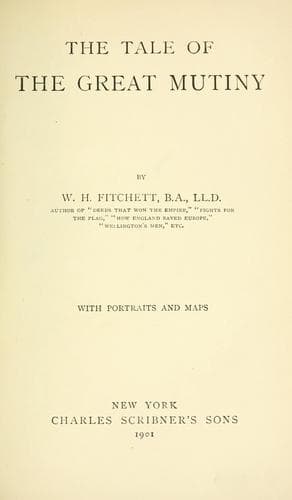
The Tale of the Great MutinyFitchett, W. H. (William Henry)
History
The Tale of the Great Mutiny
Fitchett, W. H. (William Henry)
India -- History -- Sepoy Rebellion, 1857-1858
Three boats out of the forty, meanwhile, had actually got away. Two
drifted to the Oude shore, and were overtaken by instant massacre.
One boat, however, had for the moment a happier fate. It caught the
mid-current of the Ganges, and went drifting downwards; and that solitary
drifting boat, without oars or rudder, bearing up in its crazy planks
above the dark waters of the Ganges the sole survivors of the heroic
garrison of Cawnpore, started on a wilder, stranger voyage than is
recorded elsewhere in all history.
It was Vibart’s boat; and by a curious chance it included in its
passengers the most heroic spirits in the garrison. Moore was there, and
Ashe, and Delafosse; Mowbray Thomson swam out to it from his own boat,
and with him Murphy, a private of the 32nd—two of the four who finally
survived out of the whole garrison. The boat was intended to carry only
fifty, but nearly a hundred fugitives were crowded within its crazy sides.
A cannon-shot smashed its rudder. It had no oars nor food. From either
bank a hail of shot pursued it. Every now and again the clumsy boat would
ground on some shallow; then, while the Sepoys shot fast and furiously, a
group of officers would jump overboard, and push the clumsy craft afloat
again.
Moore, pushing at the boat in this fashion, with broken collar-bone,
was shot through the heart. Ashe and Bowden and Glanville shared the
same fate. Soon the dying and the dead on the deck of this shot-pelted
boat were as many as the living. “We had no food in the boat,” wrote
Mowbray Thomson afterwards; “the water of the Ganges was all that passed
our lips. The wounded and the dead were often entangled together in the
bottom of the boat.”
When evening came the boat ran heavily aground. Under the screen of
darkness the women and children were landed, and the boat, with great
effort, floated again; the Sepoys accompanying the operation with
volleys of musketry, flights of burning arrows, and even a clumsy attempt
at a fire-ship. “No one slept that night, and no one ate, for food there
was none on board.”
When day broke the tragical voyage was continued, still to an
accompaniment of musketry bullets. At two o’clock the boat stranded
again. “Major Vibart,” says Mowbray Thomson, “had been shot through one
arm on the preceding day. Nevertheless, he got out, and, while helping
to push off the boat, was shot through the other arm. Captain Turner had
both his legs smashed, Captain Whiting was killed, Lieutenant Harrison
was shot dead.” These are sample records from that strange log.
Public-domain text, read in full here on John Shaqi.
Reviews
Reviews
No reviews yet
Be the first to share your thoughts on this work.
Elsewhere in the archive
Join the Discussion
Join the discussion
Sign in to leave a comment or review.
Sign InorCreate an account