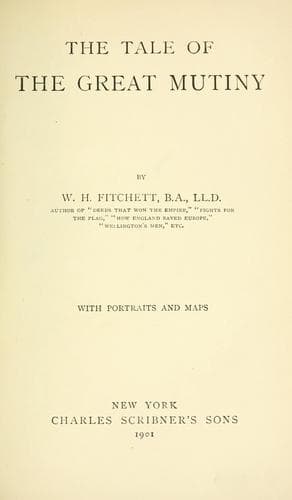
The Tale of the Great MutinyFitchett, W. H. (William Henry)
History
The Tale of the Great Mutiny
Fitchett, W. H. (William Henry)
India -- History -- Sepoy Rebellion, 1857-1858
It is curious, in view of Havelock’s achievements and after-fame, to
read in the current literature of the moment, the impression he made
upon hasty critics in Calcutta and elsewhere. The _Friend of India_,
the leading Calcutta journal, described him as a “fossil general”!
Lady Canning, in her journal, writes: “General Havelock is not in
fashion. No doubt he is fussy and tiresome; but his little, old,
stiff figure looks as active and fit for use as if he were made of
steel.” She again and again refers to “dear little old Havelock, with
his fussiness”—“fussiness” being in this case, little more than the
impatience of a strong will set to a great task, and fretted by threads
of red tape. Lord Hardinge had said, “If India is ever in danger, let
Havelock be put in command of an army, and it will be saved.” And
Havelock’s after-history amply justified that prediction.
Havelock had about the tiniest force that ever set forth to the task of
saving an empire. It never was able to put on the actual battlefield
1500 men. There were 76 men of the Royal Artillery; less than 400 of
the Madras Fusileers; less than 300 of the 78th Highlanders; 435 men
of the 64th, and 190 of the 84th, with 450 Sikhs of somewhat doubtful
loyalty, and 50 native irregular horse, whose disloyalty was not in the
least doubtful. Havelock’s reliable cavalry consisted of 20 volunteers,
amateurs mostly, under Barrow.
Measured against the scale of modern armies, Havelock’s force seems
little more than a corporal’s guard. But the fighting value of this
little army was not to be measured by counting its files. “Better
soldiers,” says Archibald Forbes, “have never trod this earth.” They
commenced their march from Allahabad on July 7; they marched, and fought,
and conquered under the intolerable heat of an Indian midsummer, and
against overwhelming odds; until when, on September 19—little more than
eight weeks afterwards—Outram and Havelock crossed the Ganges in their
advance on Lucknow, only 250 of Havelock’s “Ironsides” were left to take
part in that advance. In the whole history of the war, men have seldom
dared, and endured, and achieved more than did Havelock’s column in the
gallant but vain struggle to relieve Cawnpore.
Maude commanded its tiny battery; Hamilton led the Highlanders;
Stirling the 64th; the gallant, ill-fated Renaud, the Fusileers. Stuart
Beatson was Havelock’s assistant adjutant-general; Fraser Tytler was
his assistant quartermaster—general. Of the Highlanders—the Ross-shire
Buff’s—Forbes says, “It was a remarkable regiment; Scottish to the
backbone; Highland to the core of its heart. Its ranks were filled with
Mackenzies, Macdonalds, Tullochs, Macnabs, Rosses, Gunns, and Mackays.
The Christian name of half the Grenadier company was Donald. It could
glow with the Highland fervour; it could be sullen with the Highland
dourness; and it may be added, it could charge with the stern and
irresistible valour of the North.”
Public-domain text, read in full here on John Shaqi.
Reviews
Reviews
No reviews yet
Be the first to share your thoughts on this work.
Elsewhere in the archive
Join the Discussion
Join the discussion
Sign in to leave a comment or review.
Sign InorCreate an account