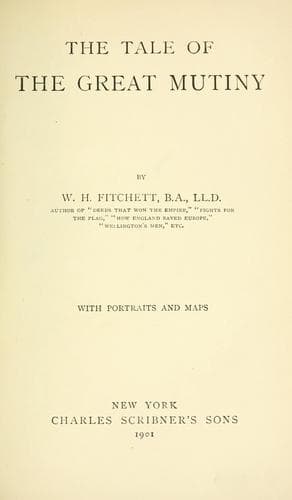
The Tale of the Great MutinyFitchett, W. H. (William Henry)
History
The Tale of the Great Mutiny
Fitchett, W. H. (William Henry)
India -- History -- Sepoy Rebellion, 1857-1858
We sneaked out of our lines into a house. I had only a
penknife, slow match, and port-fire in my hand, and was
followed close by two Europeans, and supported by a dozen
more. We expected to find the house empty, but George
Hutchinson, who was first, suddenly startled us by firing his
revolver and calling out “Here are twenty of them!” The two
Europeans—indeed, all of them—fell back a pace or two; but I
seized a musket from one, and ran forward. They followed, and I
put them in position to guard doors, while I twitted the enemy
with not showing their faces, as I did, in front of the door,
but standing with only their firelocks showing. The chaff had
the effect, for one dashed out and fired at me, but I shot him
instanter. They then bolted as I gave the word “Charge!” and we
blew up the house. Great fun and excitement in a small way!
Fulton detected a mine the enemy had driven a certain distance; he ran
a short countermine to meet it, and then sat patiently, revolver in
hand, waiting for the unconscious enemy to break through. “Some one,”
he relates, “looking for me, asked one of the Europeans if I was in the
mine. ‘Yes, sir!’ said the sergeant, ‘there he has been for the last two
hours, like a terrier at a rat-hole, and not likely to leave it either
all day!’” It was to the energy, skill, and daring of this gallant
officer that the complete defeat of the enemy’s mines was due.
The last entry in his journal is dated September 11; on September 13 he
was killed. Says Captain Birch, “The death of this brilliant officer was
occasioned by one of the most curious of wounds. He had been inspecting
a new battery in an earthwork opposite Mr. Gubbins’s house. He was lying
at full length in one of the embrasures, with a telescope in his hand. He
turned his face, with a smile on it, and said: ‘They are just going to
fire,’ and sure enough they did! The shot took away the whole of the back
of Captain Fulton’s head, leaving his face like a mask still on his neck.
When he was laid out on his back on a bed, we could not see how he had
been killed. His was the most important loss we had sustained after that
of Sir Henry Lawrence.”
[Illustration: MAJOR-GENERAL SIR HENRY HAVELOCK, K.C.B.
_From an engraving_]
CHAPTER VII
LUCKNOW AND HAVELOCK
Lucknow is only forty-five miles from Cawnpore. On July 25, Havelock,
at the head of his tiny but gallant force, by this time tempered in the
flame of battle to the quality of mere steel, crossed the Ganges in
a tempest of rain, and started to rescue the beleaguered garrison of
Lucknow from the fate of Cawnpore. But it was not until September 25 that
Outram and Havelock clambered through the shot-battered gun embrasure in
the low wall beside the Bailey Guard at Lucknow, and brought relief to
the hard-pressed garrison. And the story of those nine weeks is scribbled
over with records of daring and of achievement unsurpassed in the history
of war.
Public-domain text, read in full here on John Shaqi.
Reviews
Reviews
No reviews yet
Be the first to share your thoughts on this work.
Elsewhere in the archive
Join the Discussion
Join the discussion
Sign in to leave a comment or review.
Sign InorCreate an account