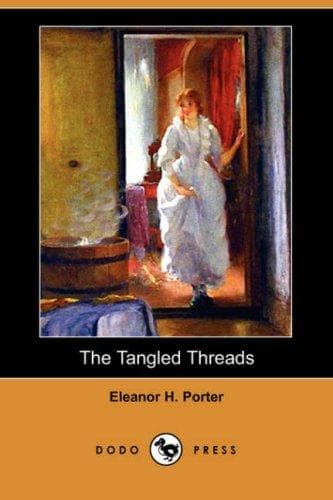
The Tangled ThreadsPorter, Eleanor H. (Eleanor Hodgman)
General
The Tangled Threads
Porter, Eleanor H. (Eleanor Hodgman)
Children's stories, American; Short stories
Mrs. Livingstone adored art--Art with a capital A, not the kind whose
sign-manual is a milking-stool or a beribboned picture frame. The
family had lived for some time in a shabby-genteel house on Beacon
Hill, ever since, indeed, Mrs. Livingstone had insisted on her
husband's leaving the town of his birth and moving to Boston--the
center of Art (according to Mrs. Livingstone).
Here she attended the Symphony Concerts (on twenty-five cent tickets),
and prattled knowingly of Mozart and Beethoven; and here she listened
to Patti or Bernhardt from the third balcony of the Boston Theater. If
she attended an exhibit of modern paintings she saw no beauty in
pictured face or flower, but longed audibly for the masterpieces of
Rubens and of Titian; and she ignored the ordinary books and
periodicals of the day, even to the newspapers, and adorned her
center-table with copies of Shakespeare and of Milton.
To be sure, she occasionally read a novel or a book of poems a trifle
less ancient in character, but never unless the world had rung with the
author's praises for at least a score of years. The stamp of Time's
approval was absolutely necessary to the aspirant after Mrs.
Livingstone's approbation. Indeed, there was only one of the
present-day celebrities who interested the good lady at all, but that
one attracted with a power that compensated for any lack in the others.
She would have given much--had it been hers to give--to once meet that
man.
Of course he was famous--he had been for thirty years. She called him
the "Inimitable One," and set him up in her heart and groveled joyfully
at his feet. She bought each of his books when published, whether she
had shoes to her feet or clothes to her back. He was the Prophet--the
High Priest--the embodiment of Art. She occasionally even allowed his
books to rest on the table along with Milton and Shakespeare.
Mrs. Livingstone's husband was only an ordinary being who knew nothing
whatever of Art; and it was a relief to her--and perhaps to him, poor
man--when he departed this life, and left her to an artistic widowhood
with anything but an artistic income--if size counts in Art. But one
must eat, and one must wear clothes (in chilly, civilized Boston, at
least), and Mrs. Livingstone suddenly realized that something must be
done toward supplying these necessities of life for herself and her
young daughter, Mabel.
It was at about this time that there came a sharp ring at the doorbell,
and a stout man with small, but very bright, black eyes asked to see
Mrs. Livingstone.
"I have come, my dear madam, on a matter of business," said he suavely;
"and though I am a stranger to you, you certainly are not one to me. I
said 'business,' madam, yet I and the one for whom I am speaking are so
anxious that you should look favorably upon our proposition that I had
almost said that I had come to ask a favor."
Mrs. Livingstone relaxed from the forbidding aspect she had assumed,
and looked mildly interested.
Public-domain text, read in full here on John Shaqi.
Reviews
Reviews
No reviews yet
Be the first to share your thoughts on this work.
Elsewhere in the archive
Join the Discussion
Join the discussion
Sign in to leave a comment or review.
Sign InorCreate an account