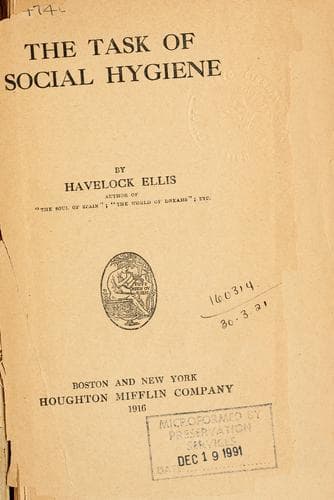
Eugenics; Sexual ethics; Women -- Social and moral questions
It is frequently assumed, as we have seen, that the process by which
civilization is thus evolved is a selfish and immoral process. To
procreate large families, it is said, is unselfish and moral, as well as
a patriotic, even a religious duty. This assumption, we now find, is a
little too hasty and is even the reverse of the truth; it is necessary
to take into consideration the totality of the social phenomena
accompanying a high birth-rate, more especially under the conditions of
town life. A community in which children are born rapidly is necessarily
in an unstable position; it is growing so quickly that there is
insufficient time for the conditions of life to be equalized. The state
of ill-adjustment is chronic; the pressure is lifted from off the
natural impulse of procreation, but is increased on all the conditions
under which the impulse is exerted. There is increased overcrowding,
increased filth, increased disease, increased death. It can never
happen, in modern times, that the readjustment of the conditions of life
can be made to keep pace with a high birth-rate. It is sufficient if we
consider the case of English towns, of London in particular, during the
period when British prosperity was most rapidly increasing, and the
birth-rate nearing its maximum, in the middle of the great Victorian
epoch, of which Englishmen are, for many reasons, so proud. It was
certainly not an age lacking in either energy or philanthropy; yet, when
we read the memorable report which Chadwick wrote in 1842, on the
_Sanitary Condition of the Labouring Population of Great Britain_, or
the minute study of Bethnal Green which Gavin published in 1848 as a
type of the conditions prevailing in English towns, we realize that the
magnificence of this epoch was built up over circles of Hell to which
the imagination of Dante never attained.
Public-domain text, read in full here on John Shaqi.
Reviews
Reviews
No reviews yet
Be the first to share your thoughts on this work.
Elsewhere in the archive
Join the Discussion
Join the discussion
Sign in to leave a comment or review.
Sign InorCreate an account