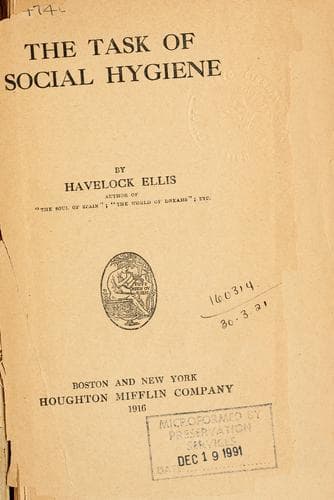
Eugenics; Sexual ethics; Women -- Social and moral questions
By happy inspiration, or by chance, Galton made public his programme of
eugenic research, in a paper read before the Sociological Society, on
February 14, the festival of St. Valentine. Although the ancient
observances of that day have now died out, St. Valentine was for many
centuries the patron saint of sexual selection, more especially in
England. It can scarcely be said that any credit in this matter belongs
to the venerable saint himself; it was by an accident that he achieved
his conspicuous position in the world. He was simply a pious Christian
who was beheaded for his faith in Rome under Claudius. But it so
happened that his festival fell at that period in early spring when
birds were believed to pair, and when youths and maidens were accustomed
to select partners for themselves or for others. This custom--which has
been studied together with many allied primitive practices by
Mannhardt[154]--was not always carried out on February 14, sometimes it
took place a little later. In England, where it was strictly associated
with St. Valentine's Day, the custom was referred to by Lydgate, and by
Charles of Orleans in the rondeaus and ballades he wrote during his long
imprisonment in England. The name Valentins or Valentines was also
introduced into France (where the custom had long existed) to designate
the young couples thus constituted. This method of sexual selection,
half playful, half serious, flourished especially in the region between
England, the Moselle, and the Tyrol. The essential part of the custom
lay in the public choice of a fitting mate for marriageable girls.
Sometimes the question of fitness resolved itself into one of good
looks; occasionally the matter was settled by lot. There was no
compulsion about these unions; they were often little more than a game,
though at times they involved a degree of immorality which caused the
authorities to oppose them. But very frequently the sexual selection
thus exerted led to weddings, and these playful Valentine unions were
held to be a specially favourable prelude to a happy marriage.
It is scarcely necessary to show how the ancient customs associated with
St. Valentine's Day are taken up again and placed on a higher plane by
the great movement which is now beginning to shape itself among us. The
old Valentine unions were made by a process of caprice tempered more or
less by sound instincts and good sense. In the sexual selection of the
future the same results will be attained by more or less deliberate and
conscious recognition of the great laws and tendencies which
investigation is slowly bringing to light. The new St. Valentine will be
a saint of science rather than of folk-lore.
Public-domain text, read in full here on John Shaqi.
Reviews
Reviews
No reviews yet
Be the first to share your thoughts on this work.
Elsewhere in the archive
Join the Discussion
Join the discussion
Sign in to leave a comment or review.
Sign InorCreate an account