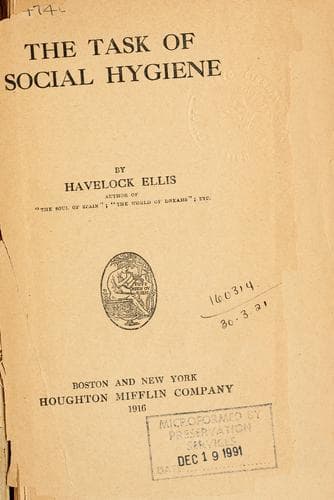
Eugenics; Sexual ethics; Women -- Social and moral questions
Prohibition by enormous majorities. The people of Maine are evidently
becoming dimly conscious that it is worse than useless to make laws
which no human power can enforce. "The result of the vote," writes Mr.
Arthur Sherwell, an English social Reformer, not himself opposed to
temperance legislation, "from every point of view, and not least from
the point of view of temperance, is eminently unsatisfactory, and it
unquestionably creates a position of great difficulty and embarrassment
for the authorities. A majority of 700 in a total poll of 120,000 is
clearly not a sufficient mandate for a drastic law which previous
experience has conclusively shown cannot be enforced successfully in the
urban districts of the State." Successful enforcement of prohibition on
a State basis would appear to be hopeless. The history of Prohibition in
Maine will for ever form an eloquent proof of the mischief which comes
when the ancient ecclesiastical failure to distinguish between the
sphere of morals and the sphere of law is perpetuated under the
conditions of modern life. The attempt to force men to render unto Caesar
the things which are God's must always end thus.
In these matters we witness in America the survival of an ancient
tradition. The early Puritans were individualists, it is true, but their
individualism took a theocratic form, and, in the name of God, they
looked upon crimes and vices equally and indistinguishably as sins. We
see exactly the same point of view in the Penitentials of the ninth
century, which were ecclesiastical codes dealing, exactly in the same
spirit and in the same way, with crime and with vice, recognizing
nothing but a certain difference in degree between murder and
masturbation. In the ninth century, and even much later, in Calvin's
Geneva and Cotton Mather's New England, it was possible to carry into
practice this theocratic conception of the unity of vices and crimes and
the punishment as sins of both alike, for the community generally
accepted that point of view. But that is very far from being the case in
the United States of to-day. The result is that in America in this
respect we find a condition of things analogous to that which existed in
France, before the Revolution remoulded the laws in accordance with the
temperament of the nation. Laws and regulations of the medieval kind,
for the moral ordering of the smallest details of life, are still
enacted in America, but they are regarded with growing contempt by the
community and even by the administrators of the laws. It is realized
that such minute inquisition into the citizen's private life can only be
effectively carried out where the citizen himself recognizes the divine
right of the inquisitor. But the theocratic conception of life no longer
corresponds to American ideas or American customs; this minute moral
legislation rests on a basis which in the course of centuries has become
rotten. Thus it has come about that nowhere in the world is there so
Public-domain text, read in full here on John Shaqi.
Reviews
Reviews
No reviews yet
Be the first to share your thoughts on this work.
Elsewhere in the archive
Join the Discussion
Join the discussion
Sign in to leave a comment or review.
Sign InorCreate an account