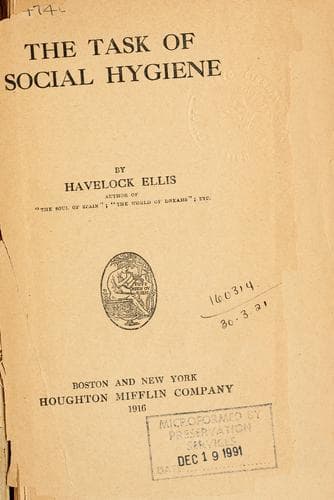
Eugenics; Sexual ethics; Women -- Social and moral questions
an unduly high limit. In New South Wales the Girls' Protection Act has
placed the age of consent at sixteen, and in the case of offences by
guardians, schoolmasters, or employers at seventeen years,
notwithstanding the vigorous opposition of a distinguished medical
member of the Legislative Council (the Hon. J.M. Creed), who presented
the arguments against so high an age. Not a single prosecution has so
far occurred under this Act.
In England the force of the moral legislation wave has been felt, but it
has been largely broken against the conservative traditions of the
country, which make all legislation, good or bad, very difficult. A
lengthy, elaborate and high-strung Prevention of Immorality Bill was
introduced in the House of Commons by a group of Nonconformists mainly
on the Liberal side. This Bill was very largely on the lines of the
Dutch law already mentioned; it proposed to raise the age of consent to
nineteen; making intercourse with a girl under that age felony,
punishable by five years' penal servitude, and any attempt at such
intercourse by two years' imprisonment. Such a measure would be, it may
be noted, peculiarly illogical and inconsistent in England and Scotland,
in both of which countries (though their laws in these matters are
independent) even a girl of twelve is legally regarded as sufficiently
mature and responsible to take to herself a husband. At one moment the
Bill seemed to have a chance of becoming law, but a group of enlightened
and independent Liberals, realizing that such a measure would introduce
intolerable social conditions, organized resistance and prevented the
acceptance of the Bill.
The chief organization in England at the present time for the promotion
of public morality is the National Council of Public Morals, which is a
very influential body, with many able and distinguished supporters.
Law-enforced morality, however, constitutes but a very small part of the
reforms advocated by this organization, which is far more concerned with
the home, the school, the Church, and the influences which operate in
those spheres. It has lately to a considerable extent joined hands with
the workers in the eugenic movement, advocating sexual hygiene and
racial betterment, thus allying itself with one of the most hopeful
movements of our day. Certainly there may be some amount of zeal not
according to knowledge in the activities of the National Council of
Public Morals, but there is also very much that is genuinely
enlightened, and the very fact that the Council includes representatives
from so many fields of action and so many schools of thought largely
saves it from running into practical excesses. Its influence on the
whole is beneficial, because, although it may not be altogether averse
to moral legislation, it recognizes that the policeman is a very feeble
guide in these matters, and that the fundamental and essential way of
bettering the public morality is by enlightening the private conscience.
Public-domain text, read in full here on John Shaqi.
Reviews
Reviews
No reviews yet
Be the first to share your thoughts on this work.
Elsewhere in the archive
Join the Discussion
Join the discussion
Sign in to leave a comment or review.
Sign InorCreate an account