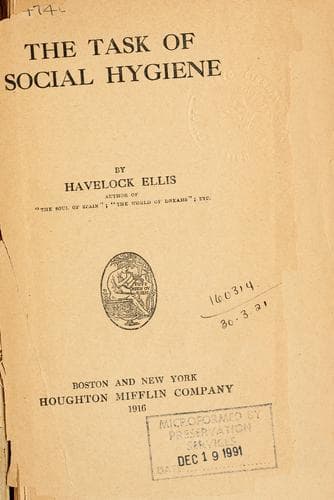
Eugenics; Sexual ethics; Women -- Social and moral questions
When we try to regulate the morals of men on the same uniform pattern we
have to remember that we are touching the most subtle, intimate, and
incalculable springs of action. It is useless to apply the crude methods
of "suppression" and "annihilation" to these complex and indestructible
forces. When Charles V retired in weariness from the greatest throne in
the world to the solitude of the monastery at Yuste, he occupied his
leisure for some weeks in trying to regulate two clocks. It proved very
difficult. One day, it is recorded, he turned to his assistant and said:
"To think that I attempted to force the reason and conscience of
thousands of men into one mould, and I cannot make two clocks agree!"
Wisdom comes to the rulers of men, sometimes, usually when they have
ceased to be rulers. It comes to the moral legislators not otherwise
than it comes to the immoral persons they legislate against. "I act
first," the French thief said; "then I think."
It seems to some people almost a paradox to assert that immorality
should not be encountered by physical force. The same people would
willingly admit that it is hopeless to rout a modern army with bows and
arrows, even with the support of a fanfare of trumpets. Yet that
metaphor, as we have seen, altogether fails to represent the inadequacy
of law in the face of immorality. We are concerned with a method of
fighting which is not merely inadequate, but, as has been demonstrated
many times during the last two thousand years, actually fortifies and
even dignifies the foe it professes to attack. But the failure of
physical force to suppress the spiritual evil of immorality by no means
indicates that a like failure would attend the more rational tactics of
opposing a spiritual force by spiritual force. The virility of our
morals is not proved by any weak attempt to call in the aid of the
secular arm of law or the ecclesiastical arm of theology. If a morality
cannot by its own proper virtue hold its opposing immorality in check
then there is something wrong with that morality. It runs the risk of
encountering a fresh and more vigorous movement of morality. Men begin
to think that, if not the whole truth, there is yet a real element of
truth in the assertion of Nietzsche: "We believe that severity,
violence, slavery, danger in the street and in the heart, secrecy,
stoicism, tempter's art and devilry of every kind, everything wicked,
tyrannical, predatory and serpentine in man, serves as well for the
elevation of the human species as its opposite."[220] To ignore altogether
the affirmation of that opposing morality, it may be, would be to breed
a race of weaklings, fatally doomed to succumb helplessly to the first
breath of temptation.
Public-domain text, read in full here on John Shaqi.
Reviews
Reviews
No reviews yet
Be the first to share your thoughts on this work.
Elsewhere in the archive
Join the Discussion
Join the discussion
Sign in to leave a comment or review.
Sign InorCreate an account