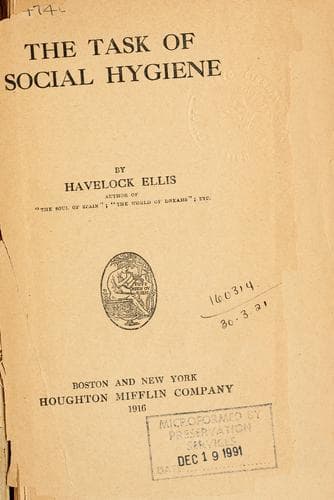
Eugenics; Sexual ethics; Women -- Social and moral questions
It is the same story elsewhere. The French long cherished the tradition
of military glory, and no country has fought so much. We see the result
to-day. In no country is the attitude of the intellectual classes so
calm and so reasonable on the subject of war, and nowhere is the popular
hostility to war so strongly marked.[228] Spain furnishes another instance
which is even still more decisive. The Spanish were of old a
pre-eminently warlike people, capable of enduring all hardships, never
fearing to face death. Their aggressively warlike and adventurous spirit
sent them to death all over the world. It cannot be said, even to-day,
that the Spaniards have lost their old tenacity and hardness of fibre,
but their passion for war and adventure was killed out three centuries
ago.
In all these and the like cases there has been a process of selective
breeding, eliminating the soldierly stocks and leaving the others to
breed the race. The men who so loved fighting that they fought till they
died had few chances of propagating their own warlike impulses. The men
who fought and ran away, the men who never fought at all, were the men
who created the new generation and transmitted to it their own
traditions.
This selective process, moreover, has not merely acted automatically; it
has been furthered by social opinion and social pressure, sometimes very
drastically expressed. Thus in the England of the Plantagenets there
grew up a class called "gentlemen"--not, as has sometimes been
supposed, a definitely defined class, though they were originally of
good birth--whose chief characteristic was that they were good fighting
men, and sought fortune by fighting. The "premier gentleman" of England,
according to Sir George Sitwell, and an entirely typical representative
of his class, was a certain glorious hero who fought with Talbot at
Agincourt, and also, as the unearthing of obscure documents shows, at
other times indulged in housebreaking, and in wounding with intent to
kill, and in "procuring the murder of one Thomas Page, who was cut to
pieces while on his knees begging for his life." There, evidently, was a
state of society highly favourable to the warlike man, highly
unfavourable to the unwarlike man whom he slew in his wrath. Nowadays,
however, there has been a revaluation of these old values. The cowardly
and no doubt plebeian Thomas Page, multiplied by the million, has
succeeded in hoisting himself into the saddle, and he revenges himself
by discrediting, hunting into the slums, and finally hanging, every
descendant he can find of the premier gentleman of Agincourt.
Public-domain text, read in full here on John Shaqi.
Reviews
Reviews
No reviews yet
Be the first to share your thoughts on this work.
Elsewhere in the archive
Join the Discussion
Join the discussion
Sign in to leave a comment or review.
Sign InorCreate an account