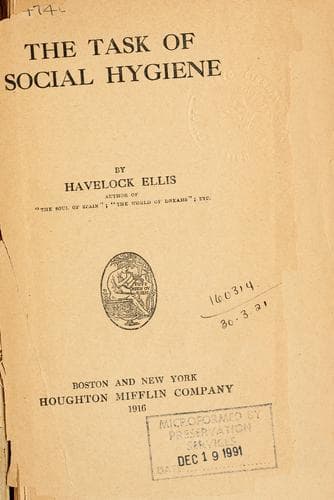
Eugenics; Sexual ethics; Women -- Social and moral questions
Among the leading nations, it is in France that the spirit of
anti-militarism has taken the deepest hold of the people, though in
some smaller lands, notably among the obstinately peaceable inhabitants
of Holland, the same spirit also flourishes. Herve, who is a leader of
the insurrectional socialists, as they are commonly called in opposition
to the purely parliamentary socialists led by Jaures,--though the
insurrectional socialists also use parliamentary methods,--may be
regarded as the most conspicuous champion of anti-militarism, and many
of his followers have suffered imprisonment as the penalty of their
convictions. In France the peasant proprietors in the country and the
organized workers in the town are alike sympathetic to anti-militarism.
The syndicalists, or labour unionists with the Confederation Generale du
Travail as their central organization, are not usually anxious to
imitate what they consider the unduly timid methods of English trade
unionists;[229] they tend to be revolutionary and anti-military. The
Congress of delegates of French Trade Unions, held at Toulouse in 1910,
passed the significant resolution that "a declaration of war should be
followed by the declaration of a general revolutionary strike." The same
tendency, though in a less radical form, is becoming international, and
the great International Socialist Congress at Copenhagen has passed a
resolution instructing the International Bureau to "take the opinion of
the organized workers of the world on the utility of a general strike
in preventing war."[230] Even the English working classes are slowly
coming into line. At a Conference of Labour Delegates, held at Leicester
in 1911, to consider the Copenhagen resolution, the policy of the
anti-military general strike was defeated by only a narrow majority, on
the ground that it required further consideration, and might be
detrimental to political action; but as most of the leaders are in
favour of the strike policy there can be no doubt that this method of
combating war will shortly be the accepted policy of the English Labour
movement. In carrying out such a policy the Labour Party expects much
help from the growing social and political power of women. The most
influential literary advocate of the Peace movement, and one of the
earliest, has been a woman, the Baroness Bertha von Suttner, and it is
held to be incredible that the wives and mothers of the people will use
their power to support an institution which represents the most brutal
method of destroying their husbands and sons. "The cause of woman," says
Novikov, "is the cause of peace." "We pay the first cost on all human
life," says Olive Schreiner.[231]
Public-domain text, read in full here on John Shaqi.
Reviews
Reviews
No reviews yet
Be the first to share your thoughts on this work.
Elsewhere in the archive
Join the Discussion
Join the discussion
Sign in to leave a comment or review.
Sign InorCreate an account