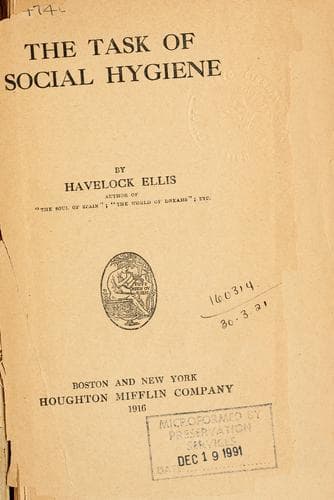
Eugenics; Sexual ethics; Women -- Social and moral questions
Thus the romantic emotions based on medieval ideals gradually lost their
worth. They were not in relation to the altered facts of life; they had
become an empty convention which could be turned to very unromantic
uses. The movement for the emancipation of women was not consciously or
directly a movement of revolt against an antiquated chivalry. It was
rather a part of the development of civilization which rendered chivalry
antique. Medieval romantic love implied in women a weakness in the soil
of which only a spiritual force could flourish. The betterment of social
conditions, the subordination of violence to order, the growing respect
for individual rights, took away the reasons for consecrating weakness
in women, and created an ever larger field in which women could freely
seek to rival men, because it is a field in which knowledge and skill
are of far more importance than muscular strength. The emancipation of
women has simply been the later and more conscious phase of the process
by which women have entered into this field and sought their share of
its rights and its responsibilities.
The woman movement of modern times, properly understood, has thus been
the effort of women to adapt themselves to the conditions of an orderly
and peaceful civilization. Education, under the changed conditions, can
effect what before needed force of arms; responsibility is now demanded
where before only tutelage was possible. A civilized society in which
women are ignorant and irresponsible is an anachronism, and, however
great the wrench with the past might be, it was necessary that women
should be adjusted to the changing times. The ideal of the weak,
ignorant, inexperienced woman--the cross between an angel and an idiot,
as I have elsewhere described her[84]--no longer fulfilled any useful
purpose. Civilized society furnishes the conditions under which all
adult persons are socially equal and all are free to give to society the
best they are capable of.
It was inevitable, but unfortunate, that this movement should have
sometimes tended to take the form of an attempt on the part of women to
secure, not merely equality with men, but actual imitation of men. These
women said that since men had attained mastery in life, captured all the
best things, and adopted the most successful methods of living, it was
necessary for women to copy them at every point. That was a specious
plea which even had in it a certain element of truth. But the fact
remained that women and men are different, that the difference is based
in fundamental natural functions, and that to place one sex in exactly
the same position as the other sex is to deform its outlines and to
hamper its activities.
Public-domain text, read in full here on John Shaqi.
Reviews
Reviews
No reviews yet
Be the first to share your thoughts on this work.
Elsewhere in the archive
Join the Discussion
Join the discussion
Sign in to leave a comment or review.
Sign InorCreate an account