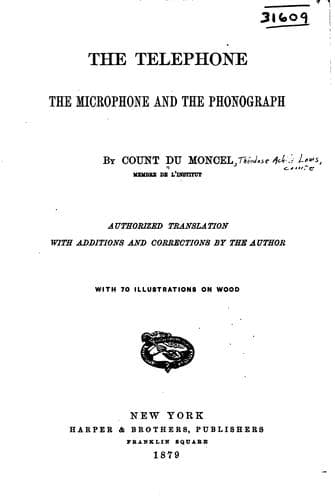
The telephone, the microphone & the phonographDu Moncel, Th., comte
History
The telephone, the microphone & the phonograph
Du Moncel, Th., comte
Microphone; Phonograph; Telephone
In order to put an end to the sputtering usual in microphones, it
occurred to M. de Courtois to prevent any cessation of contact
between the carbons by keeping them close together, and to effect the
variations of resistance necessary for articulate sounds by making them
slide over each other, so as to insert a shorter or longer portion
of the carbon in the circuit. For this purpose a vibrating disk is
placed in a vertical position in a rigid frame, and a small conducting
rod, terminated by a pointed carbon, is applied to it, with this
carbon point resting on another flat piece of carbon placed below it.
Influenced by the vibrations of the disk, the carbon point moves to and
fro, effecting more or less extensive contacts with the lower carbon,
and thus producing variations of resistance which almost correspond to
the range of vibrations on the disk.
_Experiments made with the Microphone._--I must now mention the
interesting experiments which led Mr. Hughes to the invention of
the remarkable instrument of which we have spoken, as well as those
undertaken by other scientific men, either from a scientific or a
practical point of view.
Believing that light and heat can modify the conductivity of bodies,
Mr. Hughes went on to consider whether sound vibrations, transmitted
to a conductor traversed by a current, would not also modify this
conductivity by provoking the contraction and expansion of the
conducting molecules, which would be equivalent to the shortening
or lengthening of the conductor thus affected. If such a property
existed, it would make it possible to transmit sounds to a distance,
since variations in the conductivity would result from variations
corresponding to the intensity of the current acting on the telephone.
The experiment which he made on a stretched metal wire did not,
however, fulfil his expectation, and it was only when the wire vibrated
so strongly as to break, that he heard a sound at the moment of its
fracture. When he again joined the two ends of the wire, another sound
was produced, and he soon perceived that imperfect contact between the
two broken ends of wire would enable him to obtain a sound. Mr. Hughes
was then convinced that the effects he wished to produce could only be
obtained with a divided conductor, and by means of imperfect contacts.
Public-domain text, read in full here on John Shaqi.
Reviews
Reviews
No reviews yet
Be the first to share your thoughts on this work.
Elsewhere in the archive
Join the Discussion
Join the discussion
Sign in to leave a comment or review.
Sign InorCreate an account