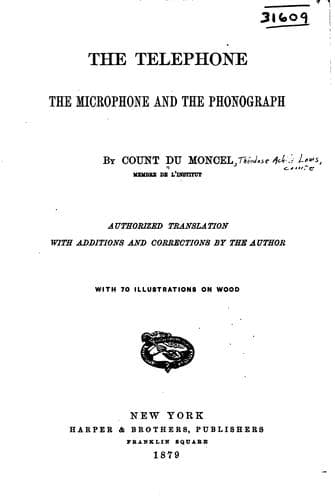
The telephone, the microphone & the phonographDu Moncel, Th., comte
History
The telephone, the microphone & the phonograph
Du Moncel, Th., comte
Microphone; Phonograph; Telephone
I have repeated Mr. Hughes’s experiments with a single Leclanché cell,
and for this purpose I employed a quill, filled with five fragments
of carbon, taken from the cylindrical carbons of small diameter which
are made by M. Carré for the electric light. I have obtained the
results which are mentioned by Mr. Hughes, but I ought to say that the
experiment is a delicate one. When the pressure of the fragments of
carbon against each other is too great, the current traverses them with
too much force to allow the calorific effects to vary the deviation
of the galvanometer, and when the pressure is too slight, the current
will not pass through them. A medium degree of pressure must therefore
be effected to ensure the success of the experiment, and when it is
obtained, it is observed that on the approach of the hand to the
tube, a deviation of 90° will, after a few seconds, diminish, so that
it seems to correspond with the approach or withdrawal of the hand.
But breathing produces the most marked effects, and I am disposed to
believe that the greater or less deviations produced by the emission
of articulate sounds when the different letters of the alphabet are
pronounced separately, are due to more or less direct emissions of
heated gas from the chest. It is certain that the letters which require
the most strongly marked sounds, such as A, F, H, I, K, L, M, N, O, P,
R, S, W, Y, Z, produce the greatest deviations of the galvanometric
needle.
In my paper on the conductivity of such bodies as are moderately good
conductors, I had already pointed out this effect of heat upon divided
substances, and I also showed that after a retrograde movement, which
is always produced at once, a movement takes place in an inverse
direction to the index of the galvanometer when heat has been applied
for some instants, and this deviation is much greater than the one
which is first indicated.
Public-domain text, read in full here on John Shaqi.
Reviews
Reviews
No reviews yet
Be the first to share your thoughts on this work.
Elsewhere in the archive
Join the Discussion
Join the discussion
Sign in to leave a comment or review.
Sign InorCreate an account