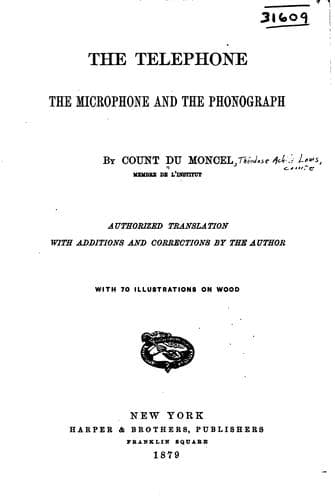
The telephone, the microphone & the phonographDu Moncel, Th., comte
History
The telephone, the microphone & the phonograph
Du Moncel, Th., comte
Microphone; Phonograph; Telephone
The slightest shock which affects the microphone has the effect
of sending currents, more or less broken, through the telephones,
which transform them into sound vibrations, and since these are
mechanically transmitted by the board to the microphone, they maintain
and even amplify its action, and produce fresh vibrations on the
telephones. Thus a fresh action is exerted on the microphone, and so
on indefinitely. Again, if a second microphone, in connection with
another telephonic circuit, be placed upon the same board, we have an
instrument which acts as a telephonic relay, that is, it transmits
to a distance the sounds communicated to the board, and these sounds
may serve either as a call, or as the elements of a message in the
Morse code, if a Morse manipulator is placed in the circuit of the
first microphone. Mr. Hughes adds that he has made several very
successful experiments with this system of instruments, although he
only employed a Daniell battery of six cells without any induction
coil. By fastening a pasteboard tube, 40 centimètres in length, to
the receiving telephone, he was able to hear in all parts of a large
room the continuous sound of the relay, the ticking of a watch, and
the scratching of a pen upon paper. He did not try to transmit speech,
since it would not have been reproduced with sufficient distinctness
under such conditions.
Since this first attempt, Mr. Hughes has arranged another and still
more curious system of microphonic relays, for which two microphones
with vertical carbons are required. He places two microphones
of this description on a board, and connects one of them with a
third microphone, which acts as a sender, while the second is in
communication with a telephone and a second battery: in this way the
words uttered before the sender are heard in the telephone, without
employing any electro-magnetic organ for the telephonic relay.
In August 1878, Messrs. Houston and Thomson likewise arranged a system
of telephonic relays which only differs from that of Mr. Hughes in
the particular of having the microphone fixed on the diaphragm of the
telephone, and not on the board beside it. The system consists of three
vertical microphones, which can be combined for tension or quantity,
according to the conditions for which they are required. The model of
this instrument was represented in the ‘Telegraphic Journal’ of August
15, 1878, to which we must refer our readers, if they wish for further
information on the subject.
Public-domain text, read in full here on John Shaqi.
Reviews
Reviews
No reviews yet
Be the first to share your thoughts on this work.
Elsewhere in the archive
Join the Discussion
Join the discussion
Sign in to leave a comment or review.
Sign InorCreate an account