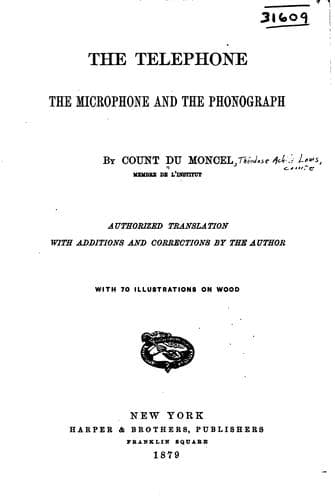
The telephone, the microphone & the phonographDu Moncel, Th., comte
History
The telephone, the microphone & the phonograph
Du Moncel, Th., comte
Microphone; Phonograph; Telephone
M. Lacour enumerates the ways in which this system may be applied as
follows: ‘If the keys in connection with the sending tuning-forks
are placed side by side, and are lowered in succession, or two or
three together, it will be enough to play on the keys as on a musical
instrument, in order that the air may be heard at the receiving
station, or the signals transmitted simultaneously may each belong to
a different message. This system will therefore allow the furthest
station on a line to communicate with one or several intermediate
stations, and _vice versa_, without disturbing the communication
at other stations. In this way two stations can exchange signals,
unperceived by the rest. The power of sending many signals at once
affords a good means of improving the autographic telegraph. In the
instruments now in use, such as those of Caselli and D’Arlincourt,
there is only one tracing stylus, and this stylus must pass over the
whole surface of the telegram in order to obtain a copy of it, but with
the telephone a certain number of styli may be placed side by side
in the form of a comb, and this comb need only be drawn in a certain
direction to pass over the surface of the telegram. In this way a more
faithful copy will be obtained in a shorter time.’
M. Lacour also observes that his system possesses a merit already
pointed out by Mr. Varley, namely, that the instruments permit the
passage of ordinary currents without revealing their presence, whence
it follows that the accidental currents which often disturb telegraphic
transmissions will have no effect on these systems.
M. Lacour began without applying an electro-magnetic system to his
instrument in order to maintain the movement of the tuning-fork,
but he soon saw that this accessory was indispensable, and he made
the tuning-forks themselves electro-magnetic. It also occurred to
him to convert the transmitted currents into pulsatory currents by
inserting an induction coil in the circuit, which was also done by
Mr. Elisha Gray. Finally, in order to obtain the immediate action
of the tuning-forks and the immediate cessation of their action, he
constructed them so as to reduce their inertia as much as possible.
This was effected by inserting the two branches of the tuning-fork in
the same coil and by lengthening its handle, and turning it back so
that it might pass through a second coil, dividing into two branches
and embracing the two vibrating branches, but without touching them.
When a current traverses both coils, it produces, in the kind of
horseshoe magnet formed by the two systems, opposite polarities which
provoke a double reaction in the vibrating branches--a reaction by
repulsion exerted by the two branches in virtue of the same polarity,
and a reaction by attraction by the other two branches in virtue of
their opposite polarities; and this double action is repeated by the
movements of a contact breaker applied to one of the vibrating branches
of the tuning-fork.
Public-domain text, read in full here on John Shaqi.
Reviews
Reviews
No reviews yet
Be the first to share your thoughts on this work.
Elsewhere in the archive
Join the Discussion
Join the discussion
Sign in to leave a comment or review.
Sign InorCreate an account