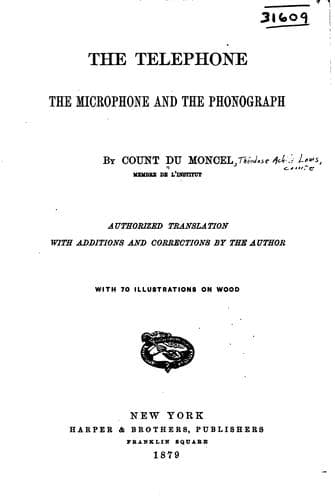
The telephone, the microphone & the phonographDu Moncel, Th., comte
History
The telephone, the microphone & the phonograph
Du Moncel, Th., comte
Microphone; Phonograph; Telephone
The instrument is not only regulated by the runner P, but also by a
regulating screw V which allows the electro-magnet M to be properly
adjusted. The regulating system is made more exact by the small screw
V, and the instrument is connected with the line by the binding screw
B. Of course this double arrangement is necessary for each of the
sending systems.
As I have already said, seven different messages might theoretically be
sent at once in this way, but Mr. Gray has only adapted his instrument
for four; he has, however, made use of the duplex system, which allows
him to double the number of transmissions, so that eight messages may
be sent at the same time, four in one direction, and four in another.
Mr. Hoskins asserts that this system has been worked with complete
success on the lines of the Western Union Telegraph Company, from
Boston to New York, and from Chicago to Milwaukee. Since these
experiments were made, fresh improvements have rendered it possible to
send a much larger number of messages.
Mr. Gray has also, aided by Mr. Hoskins, devised a system by which
telephonic messages may be sent on a wire previously used for Morse
instruments. Mr. Varley had already solved this problem, but Mr. Gray’s
system seems to have produced important results, and has therefore a
claim to our attention. We do not, however, describe it here, since it
is not within the lines marked out for us, and those who are interested
in the subject will find all the necessary details in a paper inserted
in the ‘Journal of the Society of Telegraphic Engineers, London,’ vol.
vi.
_Mr. Varley’s System._--This system is evidently the earliest in date,
since it was patented in 1870, and the patent describes the principle
of most of the arrangements which have since been adopted by Messrs.
Lacour, Gray, and Bell. It is based upon the use of his own musical
telephone, which we have already described, but with some variations in
its arrangement, which make it somewhat like the Reiss system.
Public-domain text, read in full here on John Shaqi.
Reviews
Reviews
No reviews yet
Be the first to share your thoughts on this work.
Elsewhere in the archive
Join the Discussion
Join the discussion
Sign in to leave a comment or review.
Sign InorCreate an account