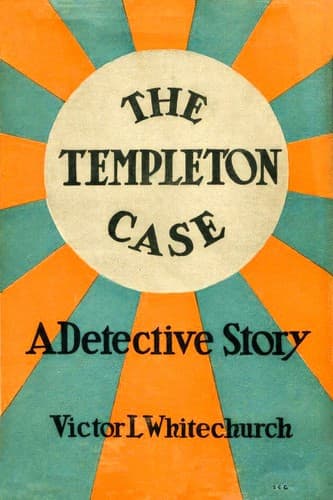
The Templeton caseWhitechurch, Victor L. (Victor Lorenzo)
General
The Templeton case
Whitechurch, Victor L. (Victor Lorenzo)
Detective and mystery stories; Murder -- Investigation -- Fiction; Police -- England -- Fiction
“Thank you, Sergeant Colson, and thank you also, Mr. Grice. The whole
affair has been terrible—very terrible. I want time to think it over.
I must say, however, Colson, that you are a very clever man to have
found out all this.”
“Thank you, sir. I did my best. And someone helped me very much. Good
night, sir. I’m very sorry all this has happened.”
Colson and Ezra Grice went out, leaving the Canon seated in his chair
gazing at the fire, his mind greatly agitated.
At the police station that night Norwood asked to be provided with
writing materials. They did so.
He smiled sardonically while they searched him and took away a
penknife and a pair of pocket nail-scissors.
But in the morning they found him hanging to the bar of the
window—they have out-of-date cells in Frattenbury—his braces
substituted for the rope that he would have eventually earned. And on
the table was a characteristic document:
I am anxious to assist my successor, though I fancy he will have no
trouble in persuading the jury as to the verdict. I am a ruined man,
with no more use for the world. Sergeant Colson’s “imagination” is
fairly correct. I will only add that I persuaded Templeton I had the
money. He had demanded cash. I showed him what appeared to be a roll
of notes—tissue-paper with some genuine ones at the top. I also told
him that unless he gave me what Ezra Grice has probably described
that night, I should abscond—with the ten thousand pounds on me. He
made a mistake in not bringing what he had for sale—he was too
cautious. It was the dagger hanging in my hall when I put my coat on
that suggested I might have to take a desperate step. I took it with
me. Templeton produced what I wanted from the locker. Then he was
fool enough to examine the roll of notes I had laid on the table.
That was the end of it. I took the contents of his pockets to make
sure in case he had anything with my name on it. I desire to say
that I regret what I did, but I was desperate that night. That is
all.
“Mr. Crosby,” said the Canon the following day—the lawyer had come
down to Frattenbury on receipt of a wire from the police—“I want to
ask you something.”
“What is it?”
“This girl, Winifred Cotterill—or Forbes, as we must call her now. If
there had been a trial, I suppose everything would have come out?”
“About her father? Certainly. Ezra Grice would have given evidence,
and the girl must have guessed.”
“I thought so. As it is, however, she has never heard about her
father’s sufferings. Poor fellow, what he must have gone through! The
matter, you tell me, rests in your hands. What are you going to do
about it? Shall you tell her the whole story?”
The lawyer thought for a minute or two, and replied shortly:
“I don’t know, Canon Fittleworth. That is a question I shall have to
consider. I haven’t made up my mind yet.”
The End
TRANSCRIBER’S NOTE
Public-domain text, read in full here on John Shaqi.
Reviews
Reviews
No reviews yet
Be the first to share your thoughts on this work.
Elsewhere in the archive
Join the Discussion
Join the discussion
Sign in to leave a comment or review.
Sign InorCreate an account