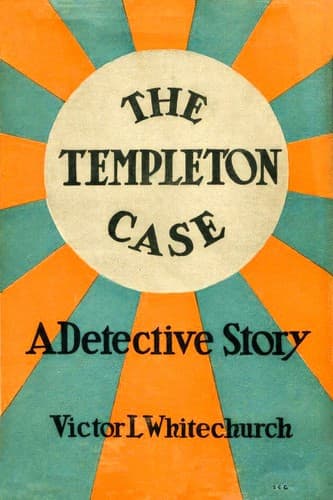
The Templeton caseWhitechurch, Victor L. (Victor Lorenzo)
General
The Templeton case
Whitechurch, Victor L. (Victor Lorenzo)
Detective and mystery stories; Murder -- Investigation -- Fiction; Police -- England -- Fiction
“Poor Uncle!” she said; “I’d rather not have had the money when it
means his death, of course. But I just can’t help being excited. Look
here, you children! You’ve both got to dine with me to-night—at the
‘Petit Cygne.’ I’ll stand treat.”
“Squanderer!” derided Maude. “Beware, Mr. Grayson! She’ll throw your
money about like ducks and drakes. I don’t think I’ll come, Winnie.”
“Why not, old thing?”
“You two irresponsible young persons having entered upon the broad
downward path that leadeth into the narrow straights of matrimony with
insufficient income will do all the talking to one another—and it will
be appalling to listen unto. That’s why.”
“I’ll promise to address quite a lot of remarks to you,” said Grayson.
“Yes, I know—‘Don’t you think Winnie looks charming to-night?’ and all
that sort of unbearable——”
“Shut up, Maude—don’t be rude. Please excuse her, Harold. I’m trying
to teach her manners—she spent the extra tuppence on frivolity. You’ll
both come, and there’s an end of it.”
“The end of it will be that I shall leave you two children at the
close of the meal, see?”
“_We_ don’t mind, do we, Harold?”
“Not a bit,” replied Grayson, as if he meant it.
“You’re not polite, Mr. Grayson,” said Maude. “If you don’t treat me
with due respect, I shall stay till the bitter end.”
But, being a good-hearted girl, of course she didn’t.
CHAPTER XV
Detective-Sergeant Colson’s Deductions
The newspaper paragraphs about the murder at Marsh Quay dwindled in
length. There were several scathing leading articles dealing with the
inefficiency of the local police, and expounding the systems that
ought to be put into force. One leader-writer produced an article
conclusively proving that the Government was to blame. Writers of that
peculiar terse and asterisked matter—the editor, it is presumed, puts
in the asterisks in exchange for the copy he deletes—which adorns the
“magazine” page of certain of our morning papers reaped a small crop
of guineas. Thus one of them described the manufacture of cigar bands
another epitomised half a dozen yacht tragedies, and a third gave a
graphic sketch of how he himself had sailed in the Marsh Quay estuary.
The Sunday papers, of course, had their contributions. “An Expert in
Crime” brilliantly reconstructed the whole murder, hinted at clues
which the police ought to have found, and, without mentioning any
names, left the impression on the mind of the reader that the two
sailor-men, to wit, Jim Webb and Tom Gale, had acted in collusion,
with the assistance of Mrs. Yates, who had countenanced a mysterious
rendezvous at the “Mariner’s Arms.”
The police were inundated with letters—suggestive and critical. People
called at the police station to make statements, which were patiently
received and laid on one side. But, as usual, the police quietly kept
their own counsel and were unimpressed.
Colson, who was now in the best of spirits, called on Canon
Fittleworth.
Public-domain text, read in full here on John Shaqi.
Reviews
Reviews
No reviews yet
Be the first to share your thoughts on this work.
Elsewhere in the archive
Join the Discussion
Join the discussion
Sign in to leave a comment or review.
Sign InorCreate an account