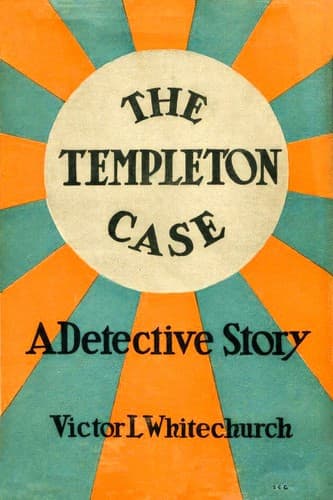
The Templeton caseWhitechurch, Victor L. (Victor Lorenzo)
General
The Templeton case
Whitechurch, Victor L. (Victor Lorenzo)
Detective and mystery stories; Murder -- Investigation -- Fiction; Police -- England -- Fiction
“Let us call the murderer A. Well, A has reason to believe that
Templeton has those diamonds, and he doesn’t know that he has
already given them to Moss. He has seen Jim Webb go off to
Frattenbury—probably found out that he was staying the night there.
And he has seen Templeton go, too. He could easily find out if he was
expected back late or not. Tom Gale knew it, Grayson knew it, Jim Webb
knew it—they talked it over in the inn. And Mrs. Yates knew it—she
told me she’d remarked about it to others.
“Well, then, A, with this information, speculates that Templeton might
leave the diamonds on board. Quite likely. It was a dark night and a
lonely walk. He determines to take a chance on this. But he can’t do
it till the coast is quite clear. That wouldn’t be till after closing
time—ten o’clock. He waits about outside, probably in the garden,
taking his stick with him. He may have armed himself with a knife—ah!
that’s it, he took a tool of some sort—very likely an old dagger, as
the doctor pointed out, to prise open any locks. Capital!
“What next? As he stood there waiting, he lighted a cigar—being an
inveterate smoker—from force of habit. He would hear the men come out
of the inn at ten o’clock; he would hear Tom Gale walk off along the
quay, and then all would be quiet, with a clear coast.
“He goes down to the shore now. The dinghy is afloat. It’s much more
simple to use her for his purpose than to run a canoe down to the
water—and less noisy. He gets into the dinghy, laying his
walking-stick down in the stern—a natural action, because the seat for
the rower is well aft—pulls out to the yacht, gets on board and makes
the dinghy fast.
“Then he lights the lamp. That’s all right, because anyone seeing it
would naturally conclude the owner is aboard. People knew he was
sleeping there that night. And he begins to make his search.
“But Templeton comes back sooner than A expected. A man doesn’t
generally leave a house where he’s dining so early. But we know
Templeton did. He sees the light on board, finds the dinghy has gone,
and wonders what is up. Possibly he jumps to the conclusion that Jim
Webb has come back after all. A canoe is lying there handy; he runs
her down to the water and paddles aboard.
“Meanwhile A, still smoking his cigar from force of habit, has burnt
it down to the band; he flicks it off, or it drops off by itself. Then
he hears Templeton coming aboard. He is caught in the act.
“He has the tool or dagger, whatever it is, in his hand. Possibly his
first impulse is to hide—behind the table. But Templeton comes into
the cabin, and, for the moment, hesitates in astonishment. The folding
table is between them—that prevents a struggle. And then the climax
comes. A, either desperate at being discovered or acting on a
murderous instinct for the sake of the jewels—he hadn’t found them,
and both lockers were open, as we know—probably the former, reaches
over the table and aims a blow at the unlucky Templeton—a blow which
proves fatal.
Public-domain text, read in full here on John Shaqi.
Reviews
Reviews
No reviews yet
Be the first to share your thoughts on this work.
Elsewhere in the archive
Join the Discussion
Join the discussion
Sign in to leave a comment or review.
Sign InorCreate an account