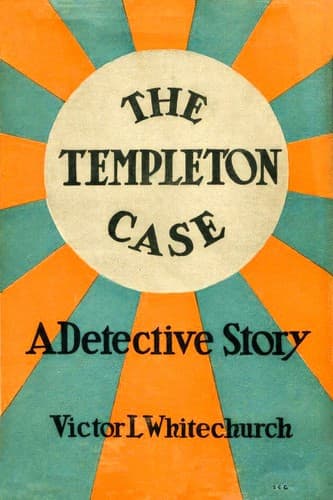
The Templeton caseWhitechurch, Victor L. (Victor Lorenzo)
General
The Templeton case
Whitechurch, Victor L. (Victor Lorenzo)
Detective and mystery stories; Murder -- Investigation -- Fiction; Police -- England -- Fiction
The way in which he really did enter the house was entirely unforeseen
by him. He went into the garden, through the little green gate, and
was beginning carefully to observe how the windows of the dining-room
opened, when, out of the front door, cigar in mouth, walked Mr.
Proctor himself. Afterwards he ascertained that Proctor had, after
walking half-way to Frattenbury, turned back and let himself in at a
door behind the house. The nondescript-looking man who carried a
fishing-rod, but whose sport seemed to fail just at the time that
Proctor started for Frattenbury, told him this hours later. At present
he made an effort to conceal his surprise and mentally said, “Damn!”
“Hallo, Mr. Colson,” said Proctor cheerily, “still trying to find out
about that nasty business, I suppose! You were coming to see me?”
The detective had no resource but to reply in the affirmative. This he
did in a perfectly natural manner.
“Well, come along in, then,” said the little man; “it’s a bit chilly
outside to-day.”
He led the way to his bachelor dining-room, and gave the detective a
chair. The latter had quite recovered his composure; in fact,
outwardly, he had not shown that he had lost it.
“Just two or three things I should like to ask you, Mr. Proctor. I
know you’re on the jury, of course, but I won’t interfere with your
prerogatives. I rather wish you’d have been summoned as a witness
instead.”
“That was the fault of the police,” said Proctor, shrugging his
shoulders. “Now, what can I tell you? Stop. Have a cigar first. I can
offer you a really good smoke.”
“Cheek,” thought Colson.
Proctor went to a cupboard by the side of the fire-place, took a bunch
of keys from his pocket and unlocked it. On a shelf were more than a
dozen boxes of cigars. Colson eyed them eagerly, but was too far off
to see them closely, and too wise to give himself away by moving.
The little man carefully selected a box, shut the cupboard and locked
it, put the box in front of Colson on the table and said:
“I think you’ll like these. Now, then, Mr. Colson?”
The detective had taken out his pocket-book and was apparently
consulting it closely. In reality he was inventing questions.
“We’re not at all satisfied, sir,” he said. “You’ve got a good view of
the estuary. You didn’t notice any other strange craft besides the
_Firefly_ about at the time the murder took place?”
“No, I didn’t.”
“It’s as well to be certain. I suppose a small boat _could_ have got
up from lower down the estuary that night?”
“Yes—certainly. The tide was flowing, you know.”
“And she could have got back?”
“There was no wind. It would have been hard rowing—unless whoever he
was waited till the tide turned.”
The detective asked several more questions and spoilt three or four
pages of his notebook by writing down replies. Then the little man
said:
“I’m just going to have tea. Won’t you have some.”
“Oh, thank you very much, if it’s not troubling you.”
Public-domain text, read in full here on John Shaqi.
Reviews
Reviews
No reviews yet
Be the first to share your thoughts on this work.
Elsewhere in the archive
Join the Discussion
Join the discussion
Sign in to leave a comment or review.
Sign InorCreate an account