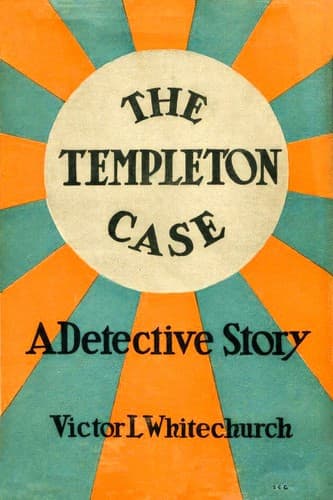
The Templeton caseWhitechurch, Victor L. (Victor Lorenzo)
General
The Templeton case
Whitechurch, Victor L. (Victor Lorenzo)
Detective and mystery stories; Murder -- Investigation -- Fiction; Police -- England -- Fiction
The first witness called was a postman who gave evidence that he had
seen the deceased coming out of the Cathedral precincts at Frattenbury
between half-past eight and nine on the Saturday evening. He, the
witness, was standing outside the post office, opposite the gateway
into the Close, where there was an electric lamp.
“Why did you not tell us this at the commencement of the inquiry?”
asked the coroner.
“Because it was only through a portrait of the deceased, published in
a newspaper afterwards, that I remembered his face, sir.”
“Very well. Did you see which way he went when he came out of the
Close?”
“Up the street, towards the Cross, sir.”
“That was all you noticed?”
“Yes, sir, nothing more.”
“Thank you.”
Isaac Moss was called next. He was terribly nervous, and gave his
evidence in such a low tone of voice that the coroner had frequently
to ask him to speak up. Bit by bit the story he had told the
superintendent and Colson was painfully dragged from him. The jury
listened attentively, and evidently one or two of them were not much
struck with his veracity. The coroner then questioned him.
“Why didn’t you inform the police at the time?”
“I was too much frightened.”
“You know that you put yourself in a very serious position, Mr. Moss?”
“Yes, I know that. I regret it very much now.”
“You say that it was after half-past twelve when you crossed the
estuary?”
“It was; it struck one just after I had left the yacht.”
“Have you anyone who can corroborate your statement that you had not
left your house before?”
“My wife is here, and my housekeeper, who brought in some hot water
for my whisky just before eleven o’clock.”
“We will hear them—for your sake,” said the coroner. “But in any case,
it is my duty to reprimand you seriously for your foolish behaviour.”
Mrs. Moss and the housekeeper having given brief evidence, a juror
said:
“May I ask you a question, sir?”
The coroner nodded.
“Isn’t it a fact that the doctor who examined the body told us last
time that the murder _might_ have been committed after midnight?”
“That is so,” replied the coroner, looking round. “The doctor is here.
Would you like him to repeat his statement?”
“If you please, sir.”
And the doctor said:
“Yes. I certainly stated that the murder might have been committed
after twelve, but not long after. The probability is that it took
place before that hour. Rigor mortis was palpably developed.”
“Thank you,” said the coroner. “Are there any more witnesses?”
There was only Joe Thatcher, who gave brief evidence as to seeing Moss
board the yacht, and gave no little amusement at his indignantly
assumed innocence when questioned as to his doings that night. The
police were careful to state that he had come forward voluntarily.
The coroner summed up briefly, not too greatly in favour of Moss, and
directed the jury to find their verdict.
“Do you wish to retire, gentlemen?”
“Yes, sir,” said the juryman who had spoken before.
Public-domain text, read in full here on John Shaqi.
Reviews
Reviews
No reviews yet
Be the first to share your thoughts on this work.
Elsewhere in the archive
Join the Discussion
Join the discussion
Sign in to leave a comment or review.
Sign InorCreate an account