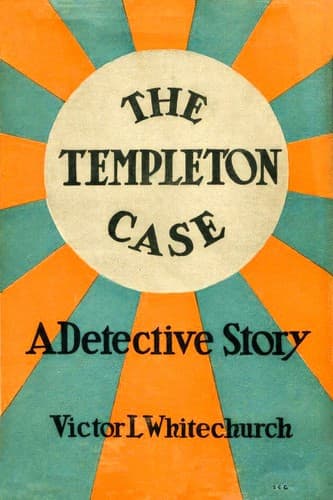
The Templeton caseWhitechurch, Victor L. (Victor Lorenzo)
General
The Templeton case
Whitechurch, Victor L. (Victor Lorenzo)
Detective and mystery stories; Murder -- Investigation -- Fiction; Police -- England -- Fiction
“I know exactly what you’re going to do,” broke in the little man
before the other could go on. “You’re going to arrest me for the
murder of Reginald Templeton, and then warn me that anything I say may
be used as evidence against me. Isn’t that so?”
For a moment or two Major Renshaw was silent with astonishment. The
superintendent gave a low whistle. Colson exclaimed:
“Great Scott!”
The Chief Constable recovered himself.
“You are right, Mr. Proctor,” he said sternly. “Take care what you
say, sir!” For Proctor was again about to speak, and he did speak, in
spite of the warning.
“One minute, Major—I beg of you, one minute. Oh, you may make use of
anything I say, and welcome. But it’s for your own sake. I’ve a strong
respect for the police. I knew you were going to arrest me. I expected
it before this.”
“You are only doing yourself harm, sir!” thundered the Chief Constable
in his best military style. “I warn you.”
“And I warn you, Major,” said the imperturbable little man, pointing
at the Chief Constable, “if you once formally arrest me, I shall
remain silent until I’m before the magistrates. And then you and your
police will be a laughing-stock. And I shan’t even have to employ a
lawyer. It’s true, Major.”
The astonished Chief Constable hesitated. He turned to the
superintendent, but the latter only shook his head in bewilderment.
Colson was hard at work biting his finger-nails. It was an
unprecedented scene.
“What do you mean, sir?” asked the Chief Constable, hesitating a
little.
“This, Major. I’ll go with you to Frattenbury with pleasure, and you
can detain me till you’re satisfied. I’ll explain everything, and you
may arrest me if you like when I’ve finished—though you won’t. But if
you do it now—I’m dumb.”
The Major took the superintendent to the other end of the room and
held a whispered conversation with him. Proctor calmly lighted a cigar
and handed his case to Colson. The latter refused it with a shake of
the head, and the little man only grinned exasperatingly at him.
Then the Major came forward.
“Very well, Mr. Proctor,” he said stiffly, “we will take you into
Frattenbury, please, on detention for the present. But I warn you that
there are ugly facts against you.”
“I know there are,” said Proctor coolly, “and I was a bit glad to hear
that Jew’s evidence just now—and to hear the doctor repeat his. But
I’ve nothing to be afraid of. I’m quite ready, Major.”
It was when they arrived at the police station that Proctor explained.
Crosby was present. The Chief Constable had told him something about
the affair as he motored him into Frattenbury.
“You may as well hear what he’s got to say,” he said.
Proctor was accommodated with a chair in the private office at the
police station. The superintendent sat at his desk, pen in hand. Major
Renshaw began:
“Now, Mr. Proctor, we will hear what you have to say, if you please.”
Public-domain text, read in full here on John Shaqi.
Reviews
Reviews
No reviews yet
Be the first to share your thoughts on this work.
Elsewhere in the archive
Join the Discussion
Join the discussion
Sign in to leave a comment or review.
Sign InorCreate an account