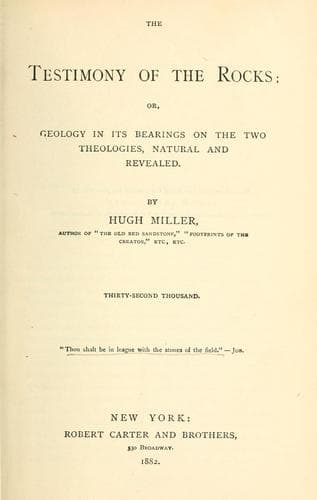
The Testimony of the Rocks: or, Geology in Its Bearings on the Two Theologies, Natural and RevealedMiller, Hugh
Philosophy
The Testimony of the Rocks: or, Geology in Its Bearings on the Two Theologies, Natural and Revealed
Miller, Hugh
Bible and geology; Creation; Religion and science
The scheme of reconciliation adopted by the late Dr. Pye Smith, though,
save in one particular, identical, as I have said, with that of Dr.
Chalmers, is made, in virtue of its single point of difference, to steer
clear of the difficulty. Both schemes exhibit the creation recorded in
Genesis as an event which took place about six thousand years ago; both
describe it as begun and completed in six natural days; and both
represent it as cut off from a previously existing creation by a chaotic
period of death and darkness. But while, according to the scheme of
Chalmers, both the Biblical creation and the previous period of death
are represented as coextensive with the globe, they are represented,
according to that of Dr. Smith, as limited and local. They may have
extended, it is said, over only a few provinces of Central Asia, in
which, when all was life and light in other parts of the globe, there
reigned for a time only death and darkness amid the welterings of a
chaotic sea; which, at the Divine command, was penetrated by light, and
occupied by dry land, and ultimately, ere the end of the creative week,
became a centre in which certain plants and animals, and finally man
himself, were created. And this scheme, by leaving to the geologist in
this country and elsewhere, save mayhap in some unknown Asiatic
district, his unbroken series, certainly does not conflict with the
facts educed by geologic discovery. It virtually removes Scripture
altogether out of the field. I must confess, however, that on this, and
on some other accounts, it has failed to satisfy me. I have stumbled,
too, at the conception of a merely local and limited chaos, in which the
darkness would be so complete, that when first penetrated by the light,
that penetration could be described as actually a _making_ or creating
of light; and that, while life obtained all around its precincts, could
yet be thoroughly void of life, A local darkness so profound as to admit
no ray of light seems to have fallen for a time on Egypt, as one of the
ten plagues; but the event was evidently miraculous; and no student of
natural science is entitled to have recourse, in order to extricate
himself out of a difficulty, to supposititious, unrecorded miracle.
Creation cannot take place without miracle; but it would be a strange
reversal of all our previous conclusions on the subject, should we have
to hold that the dead, dark, blank out of which creation arose was
miraculous also. And if, rejecting miracle, we cast ourselves on the
purely natural, we find that the local darknesses dependent on known
causes, of which we have any record in history, were always either very
imperfect, like the darkness of your London fogs, or very temporary,
like the darkness described by Pliny as occasioned by a cloud of
volcanic ashes; and so, altogether inadequate to meet the demands of a
hypothesis such as that of Dr. Smith. And yet further, I am disposed, I
Public-domain text, read in full here on John Shaqi.
Reviews
Reviews
No reviews yet
Be the first to share your thoughts on this work.
Elsewhere in the archive
Join the Discussion
Join the discussion
Sign in to leave a comment or review.
Sign InorCreate an account