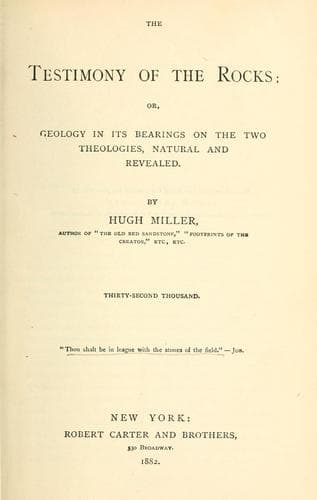
The Testimony of the Rocks: or, Geology in Its Bearings on the Two Theologies, Natural and RevealedMiller, Hugh
Philosophy
The Testimony of the Rocks: or, Geology in Its Bearings on the Two Theologies, Natural and Revealed
Miller, Hugh
Bible and geology; Creation; Religion and science
philology of Turrettine and the old Franciscans. I would, in any such
case, at once, and without hesitation, cut the philological knot, by
determining that that philology cannot be sound which would commit the
Scriptures to a science that cannot be true. Waiving, however, the
question as a philological one, and simply holding with Cuvier,
Parkinson, and Silliman, that each of the _six_ days of the Mosaic
narrative in the first chapter were what is assuredly meant by the _day_
referred to in the second,--not natural days, but lengthened periods,--I
find myself called on, as a geologist, to account for but three of the
six. Of the period during which light was created,--of the period during
which a firmament was made to separate the waters from the waters,--or
of the period during which the two great lights of the earth, with the
other heavenly bodies, became visible from the earth's surface,--we need
expect to find no record in the rocks. Let me, however, pause for a
moment, to remark the peculiar character of the language in which we are
first introduced in the Mosaic narrative to the heavenly bodies,--sun,
moon, and stars. The moon, though absolutely one of the smallest lights
of our system, is described as secondary and subordinate to only its
greatest light, the sun. It is the apparent, then, not the actual, which
we find in the passage,--what _seemed_ to be, not what _was_; and as it
was merely what appeared to be greatest that was described as greatest,
on what grounds are we to hold that it may not also have been what
_appeared_ at the time to be made that has been described as made? The
sun, moon, and stars may have been created long before, though it was
not until this fourth period of creation that they became visible from
the earth's surface.
The geologist, in his attempts to collate the Divine with the geologic
record, has, I repeat, only three of the six periods of creation to
account for,--the period of plants, the period of great sea monsters and
creeping things, and the period of cattle and beasts of the earth. He is
called on to question his systems and formations regarding the remains
of these three great periods, and of these only. And the question once
fairly stated, what, I ask, is the reply? All geologists agree in
holding that the vast geological scale naturally divides into _three_
great parts. There are many lesser divisions,--divisions into systems,
formations, deposits, beds, strata; but the master divisions, in each of
which we find a type of life so unlike that of the others, that even the
unpractised eye can detect the difference, are simply three,--the
Palæozoic, or oldest fossiliferous division; the Secondary, or middle
fossiliferous division; and the Tertiary, or latest fossiliferous
division.
Public-domain text, read in full here on John Shaqi.
Reviews
Reviews
No reviews yet
Be the first to share your thoughts on this work.
Elsewhere in the archive
Join the Discussion
Join the discussion
Sign in to leave a comment or review.
Sign InorCreate an account