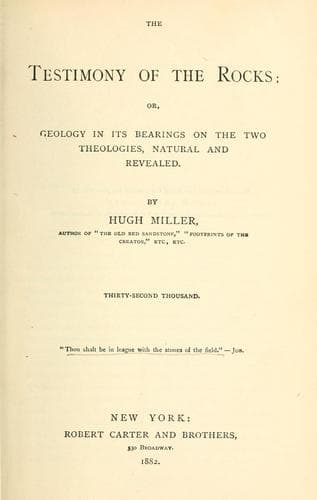
The Testimony of the Rocks: or, Geology in Its Bearings on the Two Theologies, Natural and RevealedMiller, Hugh
Philosophy
The Testimony of the Rocks: or, Geology in Its Bearings on the Two Theologies, Natural and Revealed
Miller, Hugh
Bible and geology; Creation; Religion and science
One of perhaps the most deeply interesting departments of your great
British Museum--the wonder of the world--is that noble gallery,
consisting of a suite of rooms, opening in line, the one beyond the
other, which forms its rich storehouse of organic remains. You must of
coarse remember the order in which the organisms of that gallery are
ranged. The visitor is first ushered into a spacious room devoted to
fossil plants, chiefly of the Coal Measures. And if these organisms are
in any degree less imposing in their aspect than those of the apartments
which follow in the series, it is only because that, from the exceeding
greatness of the Coal Measure plants, they can be exhibited in but bits
and fragments. Within less than an hour's walk of the Scottish capital
there are single trees of this ancient period deeply embedded in the
sandstone strata, which, though existing as mere mutilated portions of
their former selves, would yet fail to find accommodation in that great
apartment. One of those fossil trees,--a noble araucarian,--which occurs
in what is known as the Granton quarry, is a mere fragment, for it
wants both root and top, and yet what remains is sixty-one feet in
length by six feet in diameter; and beside it there lies a smaller
araucarian, also mutilated, for it wants top and branches, and _it_
measures seventy feet in length by four feet in diameter. I saw lately,
in a quarry of the Coal Measures about two miles from my dwelling-house,
near Edinburgh, the stem of a plant (_Lepidodendron Sternbergii_),
allied to the dwarfish club mosses of our moors, considerably thicker
than the body of a man, and which, reckoning on the ordinary proportions
of the plant, must have been at least seventy feet in height. And of a
kind of aquatic reed (calamites), that more resembles the diminutive
mare's tail of our marshes than aught else that now lives, remains have
been found in abundance in the same coal field, more than a foot in
diameter by thirty feet in length. Imposing, then, as are the vegetable
remains of this portion of the National Museum, they would be greatly
more imposing still did they more adequately represent the gigantic
flora of the remote age to which they belong.
[Illustration: Fig. 91.
CALAMITES CANNÆFORMIS.]
Public-domain text, read in full here on John Shaqi.
Reviews
Reviews
No reviews yet
Be the first to share your thoughts on this work.
Elsewhere in the archive
Join the Discussion
Join the discussion
Sign in to leave a comment or review.
Sign InorCreate an account